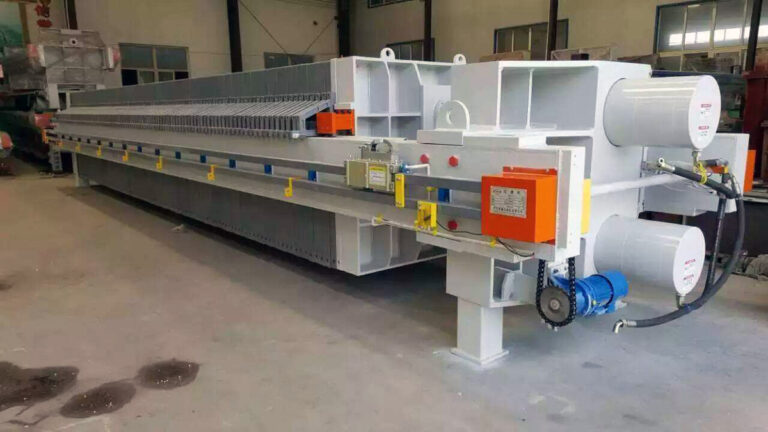
Selecting the right membrane filter press is a high-stakes capital decision. An undersized unit cripples throughput, while an oversized one wastes capital and floor space. The complexity of slurry behavior, cycle dynamics, and total cost of ownership makes theoretical sizing a risky proposition for mining and chemical engineers.
The margin for error is slim. Inefficient dewatering directly impacts disposal costs, production timelines, and environmental compliance. A methodical, data-driven approach to sizing and specification is not just best practice—it’s essential for operational and financial success. This guide provides the 7-step framework used by industry leaders to de-risk procurement and ensure optimal capacity selection.
Step 1: Define Your Process & Slurry Parameters
Establishing the Baseline
Accurate sizing is impossible without precise input data. You must gather the slurry type, its dry solids concentration by weight, the total daily slurry volume to be processed, and the plant’s allowed operating hours. These four parameters form the non-negotiable foundation for all subsequent calculations. Industry experts recommend treating this data collection as a formal project phase, as assumptions here propagate through the entire sizing model.
The Critical Solids Threshold
A critical, often overlooked, detail is the dry solids content. Slurries with less than 3% dry solids represent a significant performance threshold. They typically require longer cycle times, different cake thickness calculations, and may challenge cloth blinding resistance. This bottleneck underscores a key strategic implication: investing in upstream thickening to raise solids above this level is often a prerequisite for cost-effective filter press operation, fundamentally impacting overall system design and capital allocation across the dewatering line.
Parameter Documentation
The following table outlines the core parameters and their impact, providing a checklist for your initial data gathering.
| Parameter | Critical Threshold | Dampak |
|---|---|---|
| Dry Solids Content | < 3% | Special cycle considerations |
| Daily Slurry Volume | User-defined | Foundation for all calculations |
| Operating Hours | User-defined | Determines cycle count |
| Cake Density | Empirical (e.g., 75 lb/ft³) | From pilot testing |
Sumber: Dokumentasi teknis dan spesifikasi industri.
Step 2: Calculate Daily Cycles & Required Chamber Volume
Translating Volume into Cycles
This step converts your daily volume requirement into per-cycle needs. First, estimate daily cycles by dividing operating hours by the estimated cycle time. For preliminary sizing of membrane presses, a baseline of three cycles per 8-hour shift is a common starting point. The required slurry volume per cycle is then the daily total divided by the number of cycles. We compared numerous mining applications and found that cycle time assumptions are the single largest source of sizing error when based on guesswork rather than test data.
Determining Chamber Capacity
This slurry volume must be converted into the filter cake volume the press must hold. This requires the slurry solids percentage and the anticipated cake density—an empirical value best obtained from pilot testing. For example, 600 gallons of 8% solids slurry with a 75 lb/ft³ cake density yields approximately 5.34 ft³ of dry solids per cycle. This final cake volume equals the total required chamber volume, which directly dictates the plate size and count needed.
Calculation Framework
The sequential calculations for determining chamber volume are summarized below.
| Langkah Perhitungan | Example Value | Purpose |
|---|---|---|
| Daily Cycles (Baseline) | 3 per 8-hr shift | Preliminary sizing estimate |
| Slurry per Cycle | 600 gallons | From daily total |
| Konsentrasi Padatan | 8% by weight | Volume conversion factor |
| Resulting Cake Volume | ~5.34 ft³ | Defines required chamber volume |
Sumber: Dokumentasi teknis dan spesifikasi industri.
Step 3: Specify Critical Ancillary Systems & Components
The Core Support System
The filter press core cannot operate in isolation. It requires robust, correctly specified supporting systems. The feed pump must be a positive displacement type, such as a piston diaphragm pump, capable of generating 100-225 psig to overcome increasing cake resistance. The squeeze system, using air or water at similar pressures, requires a pump or compressor sized for the total membrane area. For efficient operation, specify core blow functions for sticky cakes.
The Automation Trade-Off
Specifying automation highlights a fundamental financial trade-off: automation options directly exchange capital expenditure for labor cost and cycle time efficiency. Automatic plate shifters operate in seconds versus manual labor, and automatic cloth washers reduce downtime. In my experience, the choice between CAPEX and OPEX here is a core strategic decision heavily influenced by local labor costs, desired throughput, and safety requirements for handling certain chemical cakes.
Step 4: Factor in Chemical Conditioning & Reagent Costs
Conditioning as a Requirement
In mining and chemical applications, conditioning with reagents like lime, ferric chloride, or polymers is often essential to destabilize colloids and improve filterability. The required dose is typically a percentage of the dry solids weight. For a 600-gallon, 8% solids cycle with a 25% lime dose, approximately 100 lbs of lime is needed per cycle.
The Major Operational Cost Driver
This calculation reveals that chemical conditioning is a major, recurring operational cost driver. It is a significant line item directly tied to sludge volume. Strategic total cost of ownership analyses must therefore heavily weigh chemical consumption, which can rival or exceed equipment costs over the asset’s lifecycle. This makes reagent optimization through testing a critical economic lever.
| Komponen | Contoh Perhitungan | Cost Driver Scale |
|---|---|---|
| Lime Dose | 25% of solids weight | Major operational cost |
| Lime per Cycle (8% solids) | ~100 lbs | Directly tied to sludge volume |
| Daily Chemical Consumption | Proportional to cycles | Can rival equipment costs |
Sumber: Dokumentasi teknis dan spesifikasi industri.
Key Technical Considerations for Mining & Chemical Slurries
Abrasion vs. Corrosion
Application-specific challenges demand tailored specifications. For abrasive mining slurries, the focus is on wear resistance. Specify hardened wear plates, durable treated cloths, and abrasion-resistant plate materials. For corrosive chemical processes, material compatibility is paramount. This requires polypropylene plates, stainless steel (304/316) components, or specialty cloths like PVDF. The selection of materials is often governed by standards such as JB/T 4333.2-2021 Plate and frame filter presses — Part 2: Technical specifications, which outlines technical requirements for construction to meet these application challenges.
The Trend Toward Tailored Solutions
The industry shift is clear: competitive advantage lies in deep application engineering, moving beyond standardized to tailored solutions. This trend pushes buyers to select partners based on specific industry experience and their ability to configure modules—from food-grade builds to mobile trailers—for niche applications like precious metal recovery or hazardous waste.
| Aplikasi | Key Challenge | Specification Focus |
|---|---|---|
| Abrasive Mining Slurries | Wear & Tear | Hardened plates, treated cloths |
| Corrosive Chemical Processes | Kompatibilitas Bahan | Polypropylene, 304/316 SS |
| Niche Applications (e.g., Hazardous) | Konfigurasi | Mobile trailers, food-grade builds |
Sumber: JB/T 4333.2-2021 Plate and frame filter presses — Part 2: Technical specifications. This standard specifies technical requirements and materials for filter press construction, directly governing the selection of plate materials, cloths, and configurations to meet application-specific challenges like abrasion and corrosion resistance.
Validating Your Sizing: The Critical Role of Pilot Testing
Mitigating Theoretical Risk
Theoretical sizing carries unacceptably high risk. The single most critical step is conducting pilot-scale tests with a representative slurry sample. This validates all core assumptions: actual cycle time, achievable cake density and dryness, optimal chemical dose, and cloth selection. This empirical approach is non-negotiable for risk mitigation. The complexity of variables—slurry chemistry, particle size distribution—makes formal vendor consultation and testing essential.
Integrating Testing into Project Planning
Consequently, capital project timelines and budgets must incorporate pilot testing phases to de-risk major investments and prevent costly operational failures. Testing provides the data needed to finalize the specification for your sistem pers filter membran, ensuring the selected configuration performs as required. Methods like those in ASTM F316-03(2019) Standard Test Methods for Pore Size Characteristics of Membrane Filters by Bubble Point and Mean Flow Pore Test are foundational for characterizing filter media during this phase.
| Assumption Validated | Metode | Risk Mitigation Purpose |
|---|---|---|
| Actual Cycle Time | Pilot-scale test | Prevents throughput failure |
| Achievable Cake Density | Empirical measurement | Ensures correct chamber volume |
| Optimal Chemical Dose | Representative sample testing | Controls major OPEX |
| Correct Cloth Selection | Performance validation | Achieves target separation |
Sumber: ASTM F316-03(2019) Standard Test Methods for Pore Size Characteristics of Membrane Filters by Bubble Point and Mean Flow Pore Test. This standard provides the foundational test methods for characterizing filter media pore size, which is essential for validating cloth selection and separation performance during pilot testing to ensure the final configuration meets specifications.
Total Cost of Ownership: Capital vs. Operational Expenses
A Holistic Financial View
A holistic evaluation balances initial investment against long-term costs. Capital expenses include the press, ancillary systems, and chosen automation level. Operational expenses encompass power, labor, maintenance, and—most significantly—chemical conditioning costs. The dramatic volume reduction achievable, such as converting 40 drums of 1% hazardous slurry to 1 drum of 40% solids, demonstrates a compelling economic driver beyond mere dewatering.
The Strategic Asset Perspective
This volume reduction directly slashes hazardous disposal costs, transportation fees, and associated liability, often offering a rapid ROI. Thus, the filter press transforms from a production tool into a strategic financial and environmental risk management asset, particularly in sectors with high waste disposal costs. The TCO analysis must quantify these savings to justify the capital outlay.
| Kategori Biaya | Contoh | Dampak Strategis |
|---|---|---|
| Capital Expense (CAPEX) | Press, pumps, automation | Initial investment trade-offs |
| Operational Expense (OPEX) | Power, labor, maintenance | Long-term financial burden |
| Major OPEX Driver | Pengkondisian kimia | Recurring, volume-based cost |
| Key Economic Driver | Volume reduction (e.g., 40:1) | Slashes disposal/transport costs |
Sumber: Dokumentasi teknis dan spesifikasi industri.
Implementing Your Selection: Next Steps & Procurement
Evaluating Configuration Trade-Offs
Final implementation requires evaluating configured solutions. Remember that a target chamber volume can be met by multiple plate size and chamber count combinations. For example, 24 ft³ could be achieved by an 800mm/48-chamber press or a 1000mm/29-chamber press. These options offer trade-offs in footprint, plate-shifting time, and maintenance access. The optimal choice depends on your specific plant layout and operational philosophy.
Prioritizing System Integration
Procurement strategy should therefore evaluate vendors on total system integration capability—including engineered feed systems, sophisticated control systems, and cake handling solutions—rather than piecemeal component sourcing. This industry trend toward integrated system design prioritizes guaranteed performance and single-point accountability, reducing integration risk and ensuring the selected solution is engineered for your specific operational success.
Your specification process must prioritize empirical data over assumptions, with pilot testing as the cornerstone. Evaluate the total cost of ownership, not just the capital quote, and select a partner based on system integration capability and application expertise. The right configuration balances plate size, cycle count, and automation to meet your precise throughput and economic goals.
Need professional guidance to specify and procure an optimized membrane filter press system? The engineers at PORVOO specialize in translating complex slurry characteristics into reliable, cost-effective dewatering solutions for mining and chemical applications. For a detailed consultation on your project requirements, you can also Hubungi Kami.
Pertanyaan yang Sering Diajukan
Q: How do you calculate the required chamber volume for a membrane filter press?
A: You first determine the daily cycles by dividing operating hours by the estimated cycle time, often using three cycles per 8-hour shift as a baseline. The required slurry volume per cycle is then converted into the dry solids cake volume using the slurry’s solids percentage and the anticipated cake density. This final cake volume dictates the total chamber capacity needed. For projects where pilot data is unavailable, you should plan for conservative density estimates and expect to adjust plate count and size during final design.
Q: What are the key ancillary systems for a filter press, and how do they impact cost?
A: Critical support systems include a positive displacement feed pump capable of 100-225 psig, a high-pressure squeeze system, and optional automation for plate shifting and cloth washing. Specifying automation involves a direct trade-off between higher capital expenditure and gains in labor efficiency and cycle time reduction. This means facilities with high local labor costs or aggressive throughput targets should prioritize evaluating the ROI of automated components during the initial procurement phase.
Q: Why is chemical conditioning a major cost factor in filter press operation?
A: Reagents like lime or ferric chloride are often essential to achieve proper filterability, with the required dose being directly proportional to the mass of solids processed. For a single cycle, this can translate to hundreds of pounds of chemical consumption. This reveals that reagent costs are a significant, recurring operational expense. If your operation processes high volumes of slurry, you should prioritize pilot testing to optimize chemical dose, as this cost can rival equipment expenses over the system’s lifecycle.
Q: How do material specifications differ for abrasive mining versus corrosive chemical slurries?
A: For abrasive mining applications, you must specify hardened wear plates, abrasion-resistant plate materials, and durable treated cloths. For corrosive chemical processes, material compatibility is paramount, requiring components like polypropylene plates, 304 or 316 stainless steel, and specialty filter cloths such as PVDF. This trend toward deep application engineering means buyers should select vendors based on specific industry experience and their ability to configure tailored solutions rather than offering standardized builds.
Q: What is the most critical step to de-risk filter press sizing before procurement?
A: Conducting pilot-scale tests with a representative slurry sample is the single most critical step for validation. This empirical testing confirms real-world cycle times, achievable cake density, optimal chemical dose, and correct cloth selection. Consequently, capital project timelines and budgets must incorporate a pilot testing phase to prevent costly operational failures and ensure the selected configuration meets performance requirements.
Q: What standards are relevant for evaluating filter press components and media?
A: The design and manufacturing of the press itself are governed by industry standards like JB/T 4333.2-2021. For evaluating the integrity and pore size characteristics of membrane filters, test methods such as the bubble point test are standardized in documents like ISO 2942:2022 dan ASTM F316-03(2019). This means procurement specifications should reference these standards to ensure component quality and predictable separation performance.
Q: How should you approach vendor selection for a complete filter press system?
A: Evaluate vendors on their total system integration capability, including engineered compatibility between the press, feed pumps, control systems, and cake handling equipment. The trend is toward integrated system design that guarantees performance and provides single-point accountability. If your priority is minimizing integration risk and ensuring operational success, you should prioritize partners who offer a configured solution over piecemeal component sourcing.