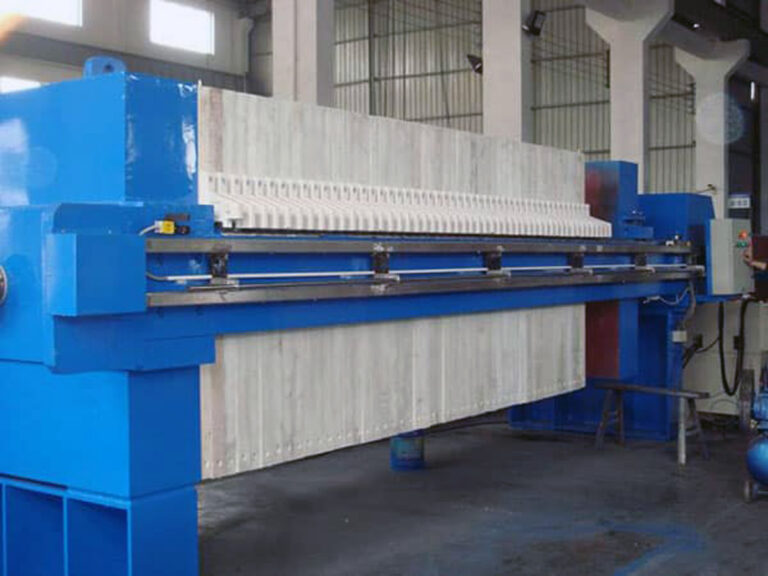
Specifying a filter press against a single average feed-solids number is one of the more reliable ways to commission a machine that cannot meet its intended duty. The equipment arrives on-site, the first production batches run long, cake moisture targets are missed, and the correction — whether a membrane retrofit, additional plate capacity, or revised cycle scheduling — happens at commissioning cost rather than specification cost. The decision that prevents that outcome is straightforward in principle: lock feed solids concentration, target cake moisture, cycle time expectation, and peak batch volume before any filtration area or chamber count is accepted from a supplier. What follows gives process and procurement teams a shared framework for confirming that those inputs are grounded in the same representative sludge test program before a quotation is released.
Which sludge sampling data should define the sizing basis
Sizing a press from an average daily flow rate is a categorical error, not a conservative simplification. A filter press does not process flow continuously; it processes discrete batches. The relevant planning unit is the volume arriving per cycle, expressed as a specific batch quantity, alongside the percent raw solids by weight that batch carries. Those two figures, combined with the target cake dryness, are the mandatory inputs for calculating the required filter volume and filtration area. Treating any one of them as approximate introduces compounding error into the sizing model from the start.
The risk is not symmetric. Underestimating batch volume means the press cannot process the full batch within the intended cycle window, generating a queue that operators can only resolve through extended run time or reduced feed frequency. Underestimating feed solids concentration leads to an inaccurate calculation of the filter cake volume the chamber must contain, which misaligns both plate count and cloth selection. Underspecifying the target cake dryness means the equipment may technically complete a cycle while consistently missing the disposal or downstream processing threshold the plant actually needs to meet.
For suspended-solids characterization during the sampling program, established test methods such as ISO 11923:1997 and ASTM D5907-18 provide a consistent measurement framework — not as sizing standards, but as the basis for ensuring that the percent-solids figure reported in the sludge program is measured and reported in a way the sizing model can use without conversion uncertainty.
| Data Point | Risk if Unclear | What the Contract Should Specify |
|---|---|---|
| Batch volume (not average flow) | Press will be undersized, unable to handle the actual batch. | Use batch volume (e.g., gallons per cycle) for sizing calculations. |
| Percent raw solids by weight | Inaccurate calculation of required filter volume and area, leading to performance mismatch. | The specific percent solids concentration used for the sizing model. |
| Target percent dryness of dewatered cake | The press may not meet the required cake moisture, affecting disposal costs. | The required cake solids percentage that the design must achieve. |
Each data point in that table carries a distinct failure mode. The practical implication is that any sizing document that leaves batch volume or feed solids concentration as a range rather than a fixed design value should be returned for resolution before filtration area calculations proceed.
How feed solids and cycle time shape required filtration area
Feed solids concentration does not merely scale the size of the press — it directly sets the duration of the compaction phase, which in turn controls how many cycles the press can complete in a given operating window. Higher feed solids shorten the time needed to build and compact the cake because a greater proportion of the incoming volume contributes to solids rather than filtrate. When that relationship is poorly understood at the specification stage, teams often treat cycle time as a fixed machine parameter rather than a variable that shifts with feed quality.
For standard chamber configurations, the planning threshold commonly used is a minimum cycle of around eight hours. That figure is a design basis for capacity modeling, not a regulatory floor, and it reflects the time needed for cake formation and drainage without mechanical squeeze assistance. The implication for daily throughput is direct: a fixed operating window divided by cycle time determines how many batches a single press can complete per day, which sets the required filtration area when combined with batch volume and cake solids data.
What changes when feed solids drift is that the assumed cycle time no longer matches actual performance. Sludge thickening variability, seasonal chemistry shifts, and upstream process changes can all move feed concentration outside the range used for sizing. A press designed to a specific area calculation based on one solids value may run longer cycles, reducing throughput, or require operators to accept wetter cake to close the cycle on time.
| Tipo de placa | Typical Cycle Time (without membrane) | Impact on Daily Capacity | Key Justification for Use |
|---|---|---|---|
| Standard Chamber Press | Mínimo 8 horas | Lower daily throughput due to longer cycles. | Lower capital cost; suitable for less stringent dryness targets. |
| Prensa de membrana | ~75-80% reduction vs. standard (e.g., ~1.6-2 hours) | Higher daily throughput due to shorter cycles. | Justified for meeting stringent cake moisture targets and increasing capacity. |
The table comparison between plate types frames a capital-versus-capacity trade-off that comes up regularly in sizing discussions. The prose point to carry forward is that feed solids concentration is the input that determines whether the standard configuration can reliably meet the cycle time the area calculation assumed — and that is the variable most often held as a single average rather than a range in early-stage specifications.
For a more detailed treatment of how filtration area and cycle time interact in the capacity calculation, the Filter Press Sizing and Capacity Calculation Guide works through the underlying methodology with specific design examples.
When cake moisture targets justify membrane squeeze instead of a standard chamber press
The decision to specify a membrane press is conditional, not a default upgrade. The justification rests on whether the target cake solids percentage falls within what a standard chamber press can reliably deliver given the sludge characteristics in question — and on whether the cost consequence of missing that target, typically through higher disposal volumes or downstream process failures, makes the capital premium defensible.
Membrane plates function by applying mechanical pressure to the formed cake after initial filtration, physically squeezing out moisture that drainage alone cannot remove. That mechanism is relevant when the sludge compressibility or the required dryness level means that extending filtration time in a standard chamber would not close the gap — or would close it only at cycle durations that make throughput unworkable. The engineering question is not whether membrane squeeze produces drier cake, which it generally does, but whether the specific cake moisture target the plant needs to meet is outside the reliable range of a standard chamber operating against the actual feed.
The mistake pattern that generates capital cost regret runs in one direction: teams choose the standard chamber configuration to reduce upfront expenditure, discover at commissioning that cake moisture consistently falls short of the disposal or process threshold, and then face the cost of either retrofitting membrane plates or operating with substandard cake dryness. That outcome is not universal — there are sludge types and moisture targets where a standard chamber press performs adequately — but it is difficult to identify which category applies without representative pilot or laboratory data on the specific sludge, not published dewatering curves for a similar material category.
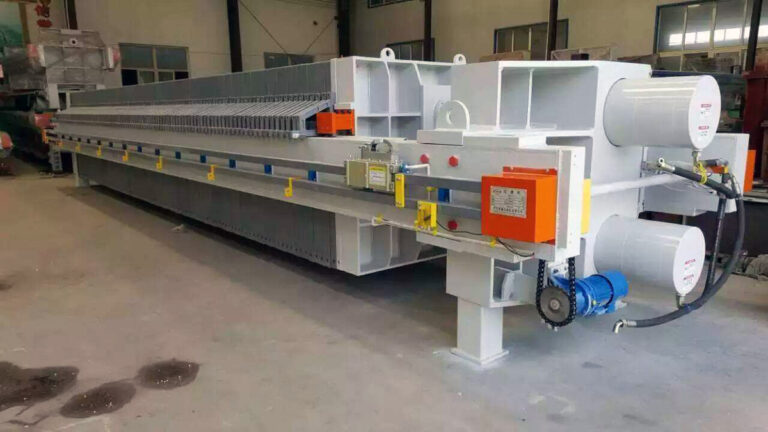
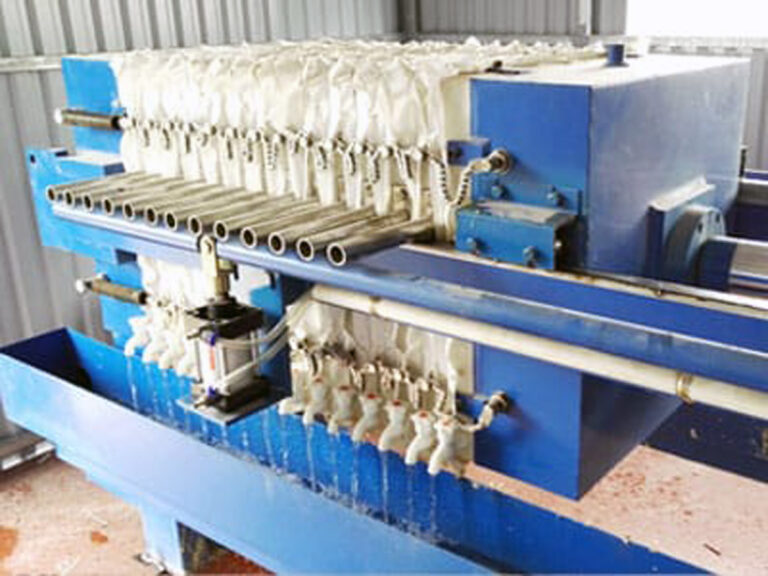
En filtro prensa de membrana y filtro prensa de placas empotradas represent the two ends of this trade-off in hardware terms. The specification decision between them should be traceable to a tested cake moisture outcome, not to an assumed performance difference.
Why peak-load assumptions matter more than average flow in many plants
The failure pattern here is well-defined: a press sized to average daily sludge generation will operate within design parameters on average days and fall behind on the days when generation exceeds that average. In plants where sludge is generated unevenly — through production scheduling, batch upstream processes, or seasonal variation in biological activity — that exceedance is not an edge case. It is a recurring condition.
The practical consequence of designing to average flow is batch backlog. The press cannot process the full volume within the available operating window, sludge accumulates in holding capacity, and operators face a choice between extended run times, reduced feed frequency, or accepting that some sludge will carry over to the next cycle. Where operating windows are fixed — for instance, in facilities running a single shift or subject to discharge time constraints — the backlog has no easy recovery path within the shift. The cost shows up as overtime, increased polymer consumption if conditioning is extended, or downstream disruption when dewatered cake is not available on schedule.
Peak-load sizing matters most where three conditions converge: batch processing windows are fixed, sludge generation is genuinely uneven, and holding capacity upstream of the press is limited. In plants where large buffer storage exists and operating schedules are flexible, the consequences of under-sizing to average flow are damping rather than acute. But those conditions should be confirmed explicitly, not assumed. The sizing document should state the peak batch volume the press is expected to handle, the cycle time within which that volume must be processed, and the basis for believing those two figures are compatible with the selected configuration.
How filtrate clarity and solids carryover affect the downstream line
Filtrate clarity is a primary performance criterion in clarification applications — situations where the liquid phase is the primary recovered product, or where the filtrate is returned to a process stream that cannot tolerate suspended solids loading above a defined threshold. In standard sludge dewatering applications where the cake is the primary output and filtrate is discharged or recycled, clarity is a secondary metric, but its failure mode still carries operational cost.
Solids carryover through the filter cloth — caused by cloth blinding, incorrect pore size selection, inadequate precoat, or bypass at plate seals — introduces suspended solids into the filtrate stream. The downstream consequence depends on where the filtrate goes. Return to a clarifier adds solids loading to a unit already managing a defined capacity. Discharge to drain against a site effluent standard creates a compliance exposure. Return to a process stream as wash or dilution water can introduce contamination that affects product quality or reaction chemistry. None of these are theoretical concerns; they are operational failure modes that become recurring maintenance and compliance issues rather than one-time events once they begin.
The cloth specification and sealing design must be matched to the specific solids character of the sludge — particle size distribution, compressibility, and chemical nature all influence how the cake forms and whether it provides the secondary filtration effect that typical press operation relies on. If the sludge program that informs the sizing basis does not include particle characterization data, the cloth selection will carry unresolved assumptions that may not surface until the press is running under production conditions.
What test package should be attached to the final filter press quotation
A quotation that does not specify the sludge parameters used to generate the sizing calculation transfers the technical risk of that omission to the buyer. The quoted filtration area, chamber count, and cycle time are only meaningful relative to a defined sludge; without that anchor, the supplier’s performance commitment is unverifiable against the sludge the plant will actually process. Accepting a quotation on that basis means any discrepancy at commissioning becomes a negotiation about whose assumptions governed, rather than a straightforward comparison against a stated design basis.
Two items in the quotation carry the most procurement risk when left vague. First, sludge-specific dewatering characteristic data — the measured dry weight per unit volume and the compressibility behavior of the specific sludge — should appear as explicit inputs to the sizing calculation, not as references to a material category or a comparable application. Generic dewatering characteristics for municipal biosolids, paper mill sludge, or chemical process residuals span wide enough ranges that the difference between a correctly sized and an undersized press can fall entirely within that variance. Second, the cycle time projection must be explicitly tied to the feed solids concentration and dewatering characteristics used for sizing. Cycle time is a variable outcome of the interaction between sludge properties, operating pressure, plate configuration, and cloth selection. A quoted cycle time that is not anchored to a specific sludge test basis is a planning estimate, not a performance commitment.
| Item to Confirm in Quotation | Risk if Vague or Absent | What to Clarify with the Supplier |
|---|---|---|
| Sludge-specific dewatering characteristic data (e.g., dry weight per cubic foot) | Sizing is based on generic assumptions, likely leading to an improperly sized press. | Confirm the exact sludge parameters used for the sizing calculation. |
| Defined test basis for cycle time (tying it to dewatering characteristics and feed solids) | Quoted cycle time is not guaranteed for your specific sludge, risking throughput shortfalls. | Require the cycle time projection to be explicitly linked to your provided sludge data. |
The practical review check is whether the numbers transferred between the process team and the procurement team — dry solids per day, required cake moisture, expected cycle time — are all traceable to the same sludge test program. When they are not, the sizing calculation contains implicit assumptions that neither side has explicitly accepted. That gap is manageable before equipment is ordered. After order release, correcting it means rework at commissioning.
For detailed guidance on translating sludge parameters into plate-and-frame sizing calculations, the Plate and Frame Filter Press Sizing and Capacity Calculation article works through filtration area, cycle time, and throughput design methods applicable to this stage of the specification process.
The practical consequence of getting this wrong is not an abstract performance shortfall — it is a press that runs long cycles, misses cake moisture targets, or falls behind on peak-load days, and where the fix requires retrofitting or renegotiating after the equipment is already installed. The inputs that prevent that outcome are available before sizing: batch volume per cycle, percent feed solids from a representative sampling program, and a defined cake moisture target tied to actual disposal or downstream requirements.
Before accepting any filtration area calculation or chamber count from a supplier, confirm that the three core inputs are fixed values traceable to test data, that cycle time is projected against the specific sludge rather than a category average, and that the quotation document explicitly states the dewatering characteristics used to generate it. Those confirmations take less time than a commissioning rework, and they are the point at which process intent and procurement commitment should be made identical.
Preguntas frecuentes
Q: What happens if the sludge feed solids concentration shifts significantly after the press is already installed and commissioned?
A: The press will likely fall outside its intended cycle window, producing wetter cake, longer cycles, or both — without any design margin to absorb the variance. Because cycle time is a direct function of feed solids concentration, a sustained shift in feed quality changes the throughput the installed area can deliver. Plants that experience thickening variability, seasonal biology changes, or upstream process adjustments should define feed solids as a range with a design-basis peak during the sizing stage, not as a single representative value, so the selected configuration retains headroom when real operating conditions diverge from the test program.
Q: If both the process team and the procurement team agree on a dry-solids-per-day figure, is that sufficient to release a filter press order?
A: No — a shared dry-solids-per-day number is necessary but not sufficient, because it does not fix the cycle time model or confirm that both teams are working from the same sludge test data. The handoff risk is that dry solids per day can be calculated from different combinations of batch volume, feed concentration, and cycle assumptions, each of which produces a different equipment size. The quotation should be released only when feed solids, cake moisture target, and cycle time projection are all explicitly traceable to the same representative sludge program — not derived independently by each team and then reconciled at the number level.
Q: At what point does the capital premium for a membrane press become difficult to justify against a standard recessed chamber configuration?
A: When the target cake moisture falls within the reliable delivery range of a standard chamber press operating against the specific sludge in question, the membrane premium is difficult to recover through disposal savings or downstream process benefit alone. The threshold is sludge-specific, not a fixed dryness percentage, which is why the justification must be based on pilot or laboratory data for the actual material rather than published performance comparisons for a similar sludge category. If representative testing shows a standard chamber consistently meeting the disposal or process threshold within an acceptable cycle window, the additional capital for membrane plates adds cost without a recoverable operational return.
Q: Does specifying a larger press to handle peak loads create problems for routine low-load operation?
A: Oversizing relative to routine loads can reduce dewatering efficiency on low-solids batches, because the cake layer that forms across the available filtration area will be thinner and may not provide the secondary filtration effect the cloth relies on for filtrate clarity. It can also extend cycle time unnecessarily on average days if operators run the press to full chamber fill rather than adjusting feed volume. The practical resolution is to size for the peak batch volume the cycle window must accommodate, then confirm during the test program that the selected configuration still performs within acceptable parameters at the lower end of the expected feed range — rather than treating oversizing as a straightforward safety margin with no operating consequence.
Q: Once the sizing inputs are locked and a quotation is accepted, what is the immediate next step before equipment manufacture begins?
A: The critical action is to verify that the dewatering characteristics and cycle time assumptions embedded in the supplier’s sizing calculation are explicitly documented in the contract or purchase specification as the performance basis. This is the last point at which discrepancies between the supplier’s sludge assumptions and the plant’s actual sludge test data can be identified and corrected without cost consequence. After order release, any mismatch becomes a commissioning dispute rather than a specification correction. Requesting the supplier’s sizing worksheet — showing the specific dry weight per unit volume, feed solids percentage, and cycle time model used — and confirming it matches the plant’s own test data should be completed before manufacture is authorized.