For cabinet shop owners and production managers, specifying the correct CFM for a 2×3 downdraft sanding table is a critical technical decision. The common mistake is assuming a standard shop vacuum provides sufficient airflow, leading to ineffective dust capture and compromised air quality. This error results in fine particulate remaining airborne, posing health risks and contaminating finishes.
Understanding the precise airflow requirements is essential for compliance with modern safety standards and for protecting long-term operational efficiency. A properly specified system directly impacts worker health, shop cleanliness, and the quality of the final product, making it a foundational investment for any professional woodworking environment.
Core CFM Requirements for a 2×3 Downdraft Sanding Table
Defining Effective Capture Velocity
Effective dust capture is defined by achieving sufficient air velocity across the entire six-square-foot work surface. Industry benchmarks converge on a requirement of 350 to 400 CFM. This range is validated by commercial units, which often specify a 350 CFM rating powered by a 1/3 HP motor. A standard shop vacuum, typically rated at 100-150 CFM, fails because its airflow becomes too diluted over the table’s area, unable to capture fine dust at the source before it becomes airborne.
The Benchmark and Its Context
This target CFM ensures the downdraft can outperform the dedicated ports on tools like random orbital and belt sanders, providing a universal capture solution. While 350-400 CFM is a robust starting point, the exact need is context-dependent. It varies with your specific tool mix, sanding media grit, and operational intensity. Shops running continuous, aggressive sanding sessions may need to target the upper end of this range to maintain consistent face velocity under varying workpiece coverage.
The following table outlines the core specifications for effective performance.
Component Specifications for Performance
| Komponen | Specification / Requirement | Key Rationale |
|---|---|---|
| Table Size | 2 ft x 3 ft (6 sq ft) | Standard work surface area |
| Target CFM Range | 350 – 400 CFM | Industry benchmark for capture |
| Typical Motor | 1/3 HP | Powers commercial units effectively |
| Shop Vacuum (Inadequate) | 100 – 150 CFM | Diluted airflow, fails capture |
Sumber: Dokumentasi teknis dan spesifikasi industri.
In our analysis of commercial offerings, we found that units meeting this CFM specification consistently reported superior capture rates for fine dust, directly impacting shop air quality readings.
Key Factors That Determine Your Required CFM
Static Pressure and Filter Resistance
The core CFM requirement is just the beginning. The blower must overcome significant static pressure created by the filter, a challenge standard shop vacuums cannot meet despite their high pressure rating. A fine filter necessary for health protection adds substantial resistance. The system’s blower must be rated to deliver the target CFM at this usable static pressure, not just at free air.
Workpiece Interference and Grid Design
Workpiece coverage presents a major design challenge. A large cabinet door or panel can block most of the table’s perforations, drastically reducing localized suction. This necessitates designing the system for the entire open table area to maintain velocity even when partially blocked. The tabletop grid design—its hole pattern, size, and total open area percentage—must be precisely balanced with the blower’s output. An overly porous grid can reduce suction velocity, while a restrictive one strains the blower.
Effective design directly impacts suction efficiency. It requires careful engineering of the top and internal plenum to maintain face velocity for different workpiece sizes, often through strategic hole patterns or supplemental perimeter suction.
The interplay of these factors dictates real-world performance.
System Performance Determinants
| Faktor | Impact on System | Design Consideration |
|---|---|---|
| Tekanan Statis | Must overcome filter resistance | Critical for fine dust capture |
| Workpiece Coverage | Blocks perforations, reduces suction | Design for entire open area |
| Grid Open Area % | Balances with blower output | Maintains face velocity |
| Plenum Design | Internal airflow management | Requires airtight seams |
Sumber: Dokumentasi teknis dan spesifikasi industri.
Self-Contained Unit vs. Central Dust Collector Connection
The Case for a Dedicated System
For many cabinet shops, a dedicated, self-contained unit with its own ~1 HP blower and filter is the operationally efficient choice. It allows for quick, quiet operation during intermittent sanding tasks without cycling a large, energy-intensive central system. This decision is often driven by work rhythm; for shops with frequent, short sanding sessions, a dedicated unit reduces mechanical wear on a large collector, lowers noise pollution, and eliminates the energy waste of running oversized equipment for a single station.
When Central Connection Makes Sense
Connecting a downdraft table to a central dust collector is powerful but frequently overkill. While it simplifies infrastructure by having one system to maintain, it can quickly clog main filters with fine finishing dust. This is inefficient for intermittent use and may violate best practices for filter management by mixing very fine particulate with coarser shop waste. However, for a shop with a permanently stationed table in constant use, and a central system correctly sized for the additional load, it can be a viable option.
Choosing the Right Blower and Filter for Your System
Blower Selection Beyond CFM
Selecting components requires looking beyond a single CFM number. The blower must be rated for the required CFM at a usable static pressure—typically a centrifugal (squirrel cage) blower from HVAC or a dedicated dust collector motor. These are engineered for sustained performance against resistance, unlike a shop vacuum motor which is designed for high pressure but low volume in a confined hose. The motor must match the load; a 1 HP motor is common for a dedicated unit delivering 350-400 CFM through a fine filter.
Filter Quality as a Safety Determinant
Filter quality is the paramount safety determinant. The system is only as effective as its filter; capturing hazardous sub-micron particles requires a filter rated for at least 1 micron, with true HEPA or MERV 15+ being the standard for health protection. Pair this with ample filter area (e.g., 230 sq. ft.) to minimize cleaning cycles and maintain stable airflow. This combination ensures the system protects long-term operator health by preventing silica and other fine particulates from recirculating, not just keeping the shop clean.
The specifications for health and performance are non-negotiable.
Critical Component Specifications
| Komponen | Critical Specification | Health & Safety Rationale |
|---|---|---|
| Blower Type | Centrifugal (squirrel cage) | Rated for CFM at static pressure |
| Filter Rating | 1 micron or finer (HEPA/MERV 15+) | Captures hazardous sub-micron particles |
| Filter Area | e.g., 230 sq ft | Minimizes cleaning, maintains airflow |
| Motor Power | ~1 HP for dedicated unit | Matches 350-400 CFM requirement |
Sumber: Dokumentasi teknis dan spesifikasi industri.
Practical Design Tips to Maximize Dust Capture
Combating Workpiece Blockage
To combat the inherent problem of workpiece blockage, incorporate a secondary perimeter suction slot. This provides an alternate capture path when the main grid is covered. Alternatively, use a movable suction scoop or a smaller auxiliary table that can be placed directly adjacent to the active sanding area on a large panel. Ensuring all internal seams in the plenum are airtight with silicone or gasketing is critical; any leakage drastically reduces effective suction at the tabletop by providing a path of less resistance for the airflow.
Material and Customization
The choice of grid material—perforated hardboard or steel—should balance durability with open area percentage. Steel offers longevity but requires precise fabrication. A growing ecosystem of modular solutions exists. Shops can now use on-demand fabrication services to create custom hold-downs, airflow baffles, or adapter shrouds for specific tools, tailoring the table to their exact processes for optimal performance beyond the off-the-shelf configuration.
Calculating the True Cost of Ownership and Operation
Beyond the Purchase Price
The initial purchase or build cost is just one component. True cost includes operational energy consumption, which favors a dedicated, correctly sized system over frequently cycling a large central collector. Filter replacement is a recurring cost dictated by filter quality and shop volume; a cheaper filter that clogs quickly or passes fine dust creates higher long-term cost and liability. Maintenance labor for emptying bins and cleaning filters must also be factored into operational overhead.
Evaluating Total ROI
The market spectrum ranges from DIY builds to industrial units exceeding $1,000, highlighting that defining duty cycle and compliance needs is essential to avoid under-specification or costly over-engineering. Evaluating ROI requires broader metrics: gains in finish quality from a dust-free environment, worker efficiency from reduced masking and cleanup, and decreased absenteeism from better air quality. This positions the downdraft table as a productivity and quality assurance station, not just a utility.
A comprehensive cost analysis informs better investment decisions.
Total Cost of Ownership Breakdown
| Komponen Biaya | Range / Consideration | Impact on ROI |
|---|---|---|
| Initial Purchase | DIY to >$1,000 industrial | Define duty cycle needs |
| Energi Operasional | Dedicated vs. central system | Favors correctly sized unit |
| Penggantian Filter | Recurring, based on volume | Dictated by filter quality |
| ROI Metrics | Finish quality, worker efficiency | Positions as productivity station |
Sumber: Dokumentasi teknis dan spesifikasi industri.
Essential Safety and Maintenance Considerations for Longevity
Compliance and Health Protection
A primary safety requirement is the filter’s ability to capture fine particulate to prevent respiratory hazards. This aligns with increasing regulatory focus on silica dust and insurance requirements, which will mandate professional-grade, certified solutions for commercial shops. Proactive investment in a proper system is a strategic risk mitigation move. Compliance with standards like NFPA 664-2020 for fire and explosion prevention is non-negotiable in a professional setting, governing the safe design and operation of all dust collection components.
Routine Maintenance Protocol
Safety and maintenance are inseparable. Regular maintenance is non-negotiable: empty collection bins before they overflow to maintain airflow and prevent backpressure that strains the motor. Clean or replace filters based on pressure drop monitoring, not a set schedule. Ensure all electrical components, including the blower motor and any table lighting, are properly grounded, especially in a dust-laden environment where static discharge poses a fire risk.
Adherence to established standards forms the backbone of a safe shop.
Safety and Maintenance Requirements
| Persyaratan | Action / Standard | Consequence of Neglect |
|---|---|---|
| Fine Particulate Capture | HEPA or MERV 15+ filter | Prevents respiratory hazards |
| Perawatan Rutin | Empty bin, clean filter | Maintains system airflow |
| Kepatuhan terhadap Peraturan | NFPA 664, silica dust rules | Mandates certified solutions |
| Electrical Safety | Proper grounding in dust | Prevents fire/explosion risk |
Sumber: NFPA 664-2020. This standard sets requirements for fire and explosion prevention in woodworking facilities, directly governing the safe design and operation of dust collection systems to mitigate combustible wood dust hazards.
How to Verify Your System’s Performance and Make Adjustments
Simple Field Verification Methods
Verification ensures your theoretical CFM translates to practical capture. Without advanced tools, perform a simple test: hold a thin plastic shaving or piece of tissue near the table surface. It should be pulled firmly and consistently against the grid across the work area. If capture is weak or uneven, first check for air leaks in the ducting connections or plenum seams using smoke or a listening device. Second, assess if the filter is clogged by checking the blower’s output or monitoring static pressure.
Performance Tuning and Adjustments
For performance tuning, partially covering unused grid sections with a board or baffle can increase suction velocity in the active working zone by reducing the total open area the blower serves. This is a practical method for working on smaller parts. Looking forward, smart systems with automated airflow control are emerging. Today, shops can seek units with Variable Frequency Drives (VFDs) to manually adjust blower speed for different tasks or workpiece coverage, optimizing performance and energy use in real-time.
Practical tests and tuning are required for optimal setup.
Performance Verification and Tuning
| Verification Method | Indicator of Performance | Tuning Action |
|---|---|---|
| Tissue/Shaving Test | Pulled firmly to grid | Confirms adequate suction |
| Check for Air Leaks | In ducting or plenum | Sealing improves velocity |
| Monitor Filter Clogging | Increased pressure drop | Clean or replace filter |
| Partial Grid Coverage | Increases local velocity | Optimize for workpiece size |
Sumber: Dokumentasi teknis dan spesifikasi industri.
Begin by validating your system meets the 350-400 CFM benchmark with a dedicated blower capable of overcoming filter pressure. Then, ensure your filter specification meets health standards, not just dust collection needs. Finally, integrate performance verification into your weekly maintenance routine to catch issues before they impact air quality or efficiency.
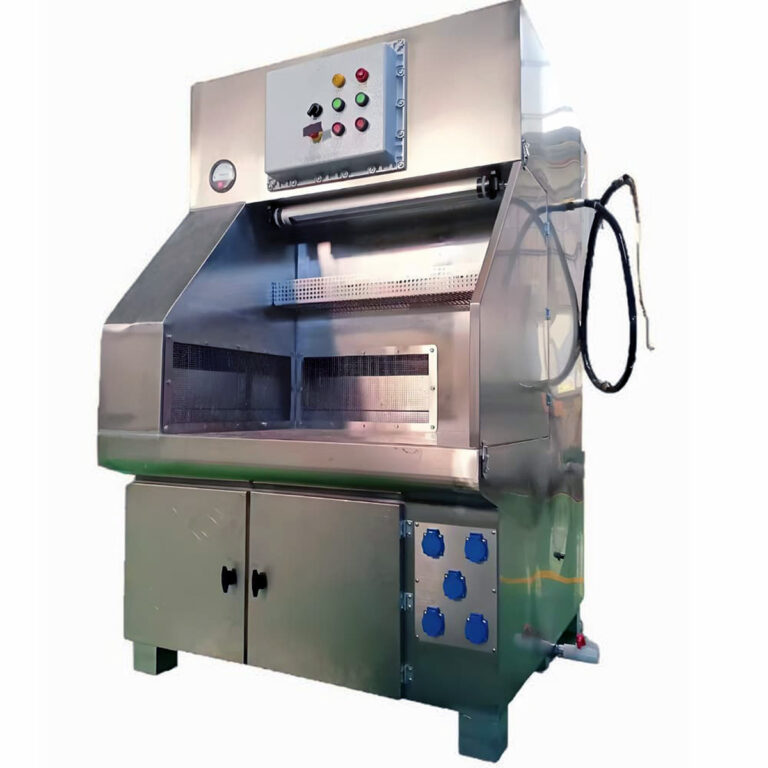
For a professionally engineered solution that balances airflow, filtration, and safety compliance, evaluate purpose-built systems like a commercial downdraft sanding table. Need a system configured for your shop’s specific workflow and volume? The engineering team at PORVOO can provide a detailed analysis.
For further discussion on your application, you can also Hubungi Kami.
Pertanyaan yang Sering Diajukan
Q: What is the baseline CFM requirement for a 2×3 downdraft sanding table, and why is a shop vacuum insufficient?
A: A 2×3-foot table requires 350 to 400 CFM to generate sufficient air velocity across its six-square-foot surface for effective fine dust capture. Commercial units confirm this, often using a 1/3 HP motor to achieve 350 CFM. A standard shop vacuum, delivering only 100-150 CFM, cannot overcome system resistance or maintain velocity, leading to poor capture. This means shops should use this CFM range as a minimum starting point for system design, not a target for a vacuum.
Q: How does connecting a downdraft table to a central dust collector compare to using a dedicated unit?
A: A dedicated, self-contained unit with its own ~1 HP blower and filter is operationally superior for intermittent sanding tasks, as it avoids cycling a large, energy-intensive central system. Tying into a central collector can be powerful but is often inefficient for short sessions and risks quickly clogging main filters with fine particulate. For shops with frequent, short sanding sessions, a dedicated unit minimizes energy waste, system wear, and noise.
Q: What filter specification is critical for protecting worker health in a downdraft table system?
A: Filter quality is the paramount safety determinant, as the system must capture hazardous sub-micron particles. You need a filter rated for at least 1 micron, with true HEPA or a MERV 15+ rating being the standard for health protection. Pair this with ample filter surface area to reduce cleaning frequency. If your operation involves sanding wood, plan for a filter that meets this standard to mitigate respiratory risks and align with growing regulatory focus on silica dust.
Q: What practical design adjustments can improve dust capture when a large workpiece blocks the table grid?
A: To combat suction loss from workpiece coverage, incorporate a secondary perimeter suction slot or use a movable suction scoop positioned near the active sanding zone. You can also temporarily cover unused grid sections with a board to increase localized air velocity. Ensuring all internal plenum seams are airtight is foundational to maintaining suction power. This means shops should design for flexibility, using modular solutions to adapt suction to the specific workpiece being processed.
Q: Beyond purchase price, what are the key factors in calculating total cost of ownership for a downdraft system?
A: True cost includes operational energy use, which favors a correctly sized dedicated system over frequently cycling a large central collector, and recurring filter replacement expenses. You must also evaluate return on investment through gains in finish quality, worker efficiency, and reduced cleanup time. For projects where compliance and daily use are priorities, plan for a professional-grade system to avoid the hidden costs of under-specification or excessive maintenance.
Q: How can I verify my downdraft table’s performance and tune it without specialized equipment?
A: Conduct a simple performance test by holding a thin plastic shaving or tissue near the table surface; it should be pulled firmly against the grid. Weak capture indicates potential air leaks in the ducting or plenum, or a clogged filter. For tuning, partially covering unused grid sections can increase suction velocity in the work zone. If your system performance is inconsistent, first methodically check for air leaks before considering component upgrades.
Q: What fire safety standard applies to dust collection systems in a professional cabinet shop?
A: Woodworking dust collection systems, including downdraft tables, must address fire and explosion hazards from combustible wood dust. The relevant standard is NFPA 664-2020, which provides requirements for prevention and protection in wood processing facilities. This means commercial shops should ensure their system design, filter selection, and maintenance protocols help meet the intent of this standard to mitigate insurance and regulatory risks.