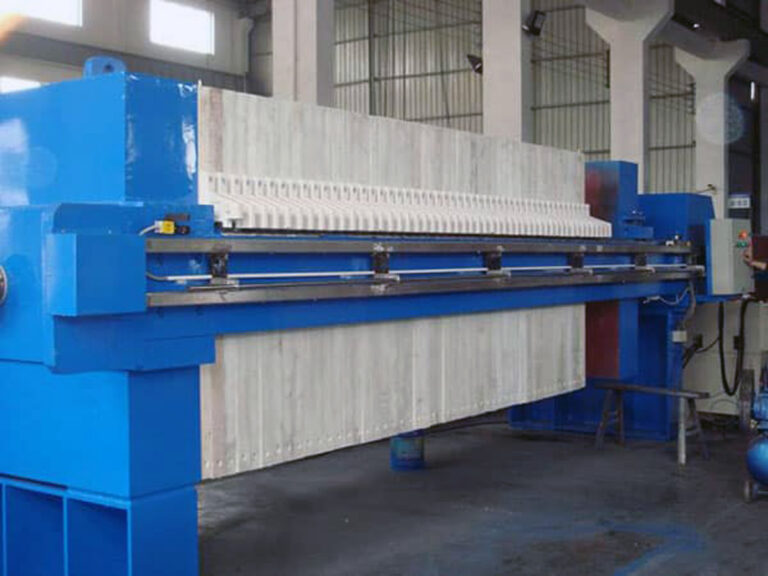
Plants that commission a belt press around throughput targets and then discover their washwater supply is inconsistent, their polymer dosing drifts between shifts, and their operators have already normalized wet cake as background noise are facing a retrofit problem that no equipment upgrade will fix. The machine is not underperforming — the operating conditions surrounding it were never confirmed against what continuous dewatering actually requires. That gap, between the procurement assumption and the daily floor reality, is where most belt press dissatisfaction originates. What resolves it is evaluating washwater reliability, staffing pattern, and maintenance discipline before the purchase order is signed, not after the first unscheduled shutdown.
Which operating conditions decide whether a belt press will stay stable
Stability in a belt press is less about the equipment specification and more about whether the incoming sludge and operating environment stay within the conditions the machine was designed to handle. When they drift outside those conditions — and in daily operation, they often do — performance deteriorates in ways that compound.
Feed solids concentration is a useful starting point. Sludge with solids below approximately 1.5% is a common planning criterion for specifying a dedicated gravity drainage zone. Without that zone, low-solids feed enters the pressure stages before free water has adequately separated, which produces inconsistent cake formation and erratic drainage. This is not a universal regulatory cutoff; it is a design threshold that should prompt a direct question to the equipment supplier: does this machine include a gravity zone dimensioned for low-solids feed, and how was that sizing determined for our sludge type?
Beyond feed concentration, two design features have an outsized effect on whether upset conditions are contained or allowed to escalate. A wedge compression zone that can be adjusted during operation — rather than only during downtime — allows operators to respond to solids migration before it reaches the belt edges and becomes a spillage event. A self-bailing perforated first dewatering drum prevents cake rewetting by allowing expressed liquid to exit the drum rather than recontact the dewatering surface. Rewetting destabilizes the pressure zone downstream; once it starts, recovering stable drainage usually requires stopping the machine rather than making incremental adjustments. These are design features that reduce upset risk, not guarantees of stable operation regardless of how the machine is run.
| Operating Condition | Stability Impact | What to Clarify Before Selection |
|---|---|---|
| Feed solids below 1.5% | Requires independent gravity zone; otherwise poor drainage and inconsistent cake | Does the belt press include a dedicated gravity zone suitable for low-solids sludge? |
| Variable wedge compression adjustment during operation | Prevents solids migration beyond belt edges and uneven cake formation | Can the wedge gap be adjusted in real time while running? |
| Self-bailing perforated first dewatering drum | Avoids rewetting of cake, which would destabilize pressure-zone performance and increase downtime | Is the first dewatering drum designed as perforated and self-bailing? |
The practical implication is that confirming these three conditions before selection — gravity zone suitability, real-time wedge adjustability, and drum design — gives procurement teams a defensible basis for comparing machines rather than relying on throughput figures alone.
How washwater availability changes the real cost of continuous dewatering
Continuous high-pressure washwater is not an optional subsystem in a belt press — it is an operational prerequisite. The belt must be cleaned on every pass to maintain drainage capacity. When wash pressure drops below design specification, most belt press designs trigger an automatic shutdown. That shutdown is not a conservative safety feature; it reflects the fact that running a partially cleaned belt quickly leads to blinding that cannot be corrected without a full stop and manual cleaning cycle. The downtime cost is not just the shutdown itself but the recovery time and the cleanup that follows.
The source of washwater introduces a real trade-off that procurement teams often underweight. Using recycled effluent from the gravity drainage zone or clarified filtrate reduces dependence on fresh mains water and lowers external water costs. That is a legitimate engineering option. However, it creates a dependency: if the recycled source is interrupted — due to upstream process changes, tank level variation, or booster pump failure — the belt press loses its wash supply and shuts down. Plants that adopt recycled washwater without accounting for source reliability effectively trade one cost for another risk. The booster pump serving the wash headers needs to be treated as critical infrastructure, not a secondary utility.
For plants evaluating whether continuous dewatering is genuinely more cost-effective than batch alternatives, washwater cost should be included in the operating cost model from the start. A belt press running continuously may use significantly more wash water per shift than a batch centrifuge cycle, and if that water comes from a pressurized mains source rather than recovered filtrate, the cost differential compounds over time. The right question before procurement is not whether the plant has water available, but whether it has water available continuously, at sufficient pressure, from a source that will not be interrupted by anything else happening in the plant on the same shift.
Where operator attention has the biggest effect on drainage and solids capture
Two process variables account for more day-to-day variation in drainage efficiency and solids capture than any mechanical component: polymer dosing consistency and wedge zone gap setting. Both respond to operator attention, and both degrade gradually when that attention is absent.
Polymer conditioning is the most upstream leverage point in belt press dewatering. If the polymer dose is insufficient, floc structure is weak and free water does not release in the gravity zone. If dosing is inconsistent between shifts — different operators calibrating by eye, or a dosing pump that has drifted out of calibration — capture efficiency varies in ways that are difficult to trace without shift-level logging. Research on automated real-time polymer dosing monitoring has indicated that consistent control of dosing can reduce polymer consumption by up to 40% while improving drainage and solids capture outcomes, based on a study of cationic polyacrylamide in sludge dewatering applications. That figure reflects a specific research context and should not be applied as a universal field guarantee, but it does indicate the scale of loss that inconsistent dosing introduces. For most plants, polymer is a significant variable cost, and manual dosing calibration frequency is a reasonable proxy for how much of that cost is being wasted on any given shift. Exploring an sistem pemberian dosis otomatis is worth evaluating as a way to reduce that variability structurally rather than managing it through operator discipline alone.
The wedge zone gap is the second highest-leverage adjustment. As feed solids concentration shifts — and it will shift during a continuous run — the optimal compression gap changes. A gap that is too open for the current feed produces wet cake; a gap that is too tight forces solids to migrate laterally toward belt edges before water has fully expressed. Operators who are not monitoring cake condition and adjusting wedge gap in response are not running the machine at its efficient point, even if nothing appears to be failing. The consequence accumulates quietly: slightly wetter cake, slightly elevated polymer use, slightly more frequent belt cleaning — none of it triggers an alarm, so it continues until a shift supervisor notices or a scheduled audit catches it.
For a more detailed treatment of how polymer conditioning interacts with each dewatering zone, the optimal polymer dosing rate guide provides zone-by-zone analysis that supports calibration decisions in practice.
Why belt cleaning and tracking issues escalate into broader plant mess and downtime
Belt blinding and tracking failure are the two failure modes most likely to convert a minor operational lapse into a plant-wide disruption, and they share a common cause: both tend to develop gradually, which means operators often adapt around them rather than correcting them.
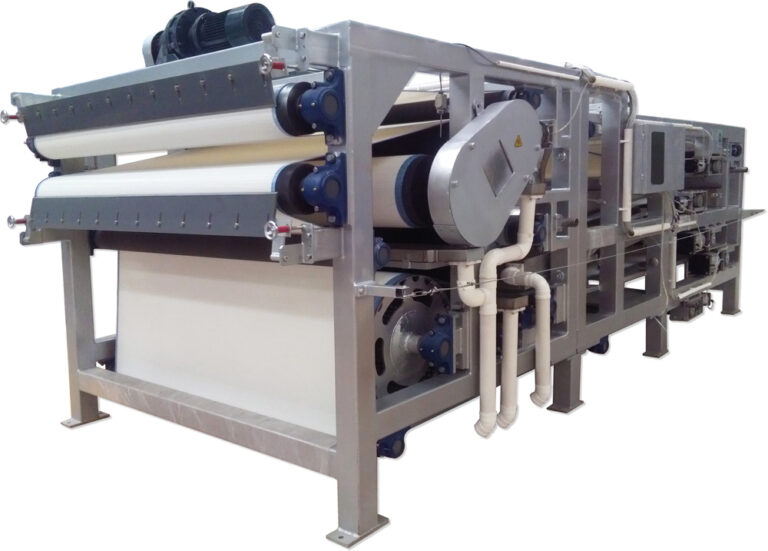
Belt blinding begins when wash pressure is insufficient to fully remove residual solids from belt pores on each pass. The drainage rate decreases, cake moisture rises, and throughput drops. If the wash system is not checked and blinding is not caught early, it reaches a point where the belt must be removed or soaked to restore drainage capacity. At that stage, the downtime extends well beyond a normal maintenance window, and the surrounding area typically requires a full cleanup before operation can resume. Sludges with high oil, fat, or grease content accelerate this process significantly — not slightly. Plants handling industrial sludges from food processing, rendering, or similar sources should treat washing frequency as a design parameter, not an afterthought, and ask the equipment supplier directly how the wash system was validated against that specific sludge chemistry.
Tracking failure introduces a different escalation pattern. Belt misalignment causes uneven pressure distribution, wrinkling, and — if not corrected — belt tearing. Most belt press designs include automatic misalignment shutdown protection, which prevents the worst damage but still results in unscheduled downtime. The more subtle risk is that minor tracking drift, which does not trigger a shutdown, causes progressive uneven wear that shortens belt life without any single event to attribute it to. When belt replacement comes earlier than expected, the root cause is often gradual tracking neglect rather than a single failure event.
Compared to a centrifuge, a belt press also requires meaningfully more external cleanup labor. That is not a criticism of the technology — it is a structural characteristic of an open-process machine running continuously with wet sludge. Plants that have not allocated housekeeping labor to the belt press area will find that accumulated residue on rollers, frames, and surrounding floors accelerates corrosion and creates slip hazards. Poor housekeeping is not just an aesthetic problem; it is a wear accelerant. The procurement decision should include an honest assessment of what housekeeping labor the plant can realistically sustain per shift, not what would be ideal.
| Issue / Risk | Escalation Consequence | What to Confirm Before Procurement |
|---|---|---|
| Inadequate belt cleaning (blinding) | Reduced drainage rate, wet cake, plant-wide cleanup required | High-pressure wash system capacity and cleaning effectiveness |
| Belt misalignment / tracking failure | Wrinkling, uneven pressure, potential tearing, automatic shutdown | Automatic belt tracking and misalignment shutdown protection |
| Greasy sludges (high oils, fats, greases) | Rapid belt blinding, more frequent washing, increased labor, compromised throughput | Cleaning requirements for high-fat sludges and wash system handling capability |
| High external cleanup labor compared to centrifuge | Poor housekeeping leads to safety hazards and accelerated component wear | Housekeeping labor expectations and cleanup access in plant layout |
How maintenance routines should be reviewed before final equipment approval
The maintenance burden of a belt press is predictable — which means it can be evaluated before procurement and costed into the operating model. The mistake is treating it as a post-commissioning discovery. By the time maintenance frequency becomes visible, the budget has been set and staffing decisions have already been made.
The regular maintenance task list for a belt press covers belt inspection, wash system pressure verification, belt tension and tracking monitoring, roller bearing lubrication, polymer system calibration, and scraper blade inspection. None of these are complex tasks, but they are recurring, and each has a consequence if deferred. Deferred belt inspection allows blinding to progress. Deferred bearing lubrication leads to water-contaminated bearing failures. Deferred blade inspection means worn blades remain in service, leaving residual cake on the belt that accelerates blinding. The cumulative effect of deferred maintenance on multiple fronts is that performance erodes across several dimensions simultaneously, and tracing the cause becomes difficult.
Frame material and component design choices made at the specification stage directly affect how often these tasks need to be performed. Stainless steel framing — typically 304 or 316 grade — is more resistant to the corrosive environment created by continuous wet sludge processing than galvanized carbon steel. That difference is not cosmetic; it affects how frequently the frame itself requires inspection and remediation, and it compounds over a machine lifetime. Split pillow block roller bearings with effective sealing reduce the frequency of bearing failures caused by water ingress. These are not universal requirements, but they are questions worth asking during the approval process, matched against the specific sludge chemistry and operating environment the machine will face.
| Component/Area | Material or Design Option | Maintenance Impact | What to Confirm Before Approval |
|---|---|---|---|
| Frame | Galvanized carbon steel vs 304/316 stainless steel | Stainless steel reduces corrosion-related maintenance and extends frame life | Material specification matches the plant’s corrosive environment and sludge chemistry |
| Roller bearings | One-size split pillow block with sealing | Sealing protects against water contamination, reducing bearing failures and maintenance frequency | Bearing design includes effective sealing and split pillow block for easier replacement |
| Discharge blades | Replaceable polypropylene blades (counterweighted) | Blades require periodic replacement; cost and lead time must be planned | Replacement interval, unit cost, and supplier availability are clarified in the maintenance budget |
Discharge blades are the most straightforward wear part to plan for: they are replaceable, they have a predictable service interval, and the cost per replacement is known. The risk is not the blade itself but the supply chain. Confirm replacement interval, unit cost, and supplier lead time before approval. A machine that requires a proprietary blade with a four-week lead time creates unplanned downtime risk that could be avoided by choosing a machine with locally available consumables or by holding sufficient stock.
What shift-level checklist should accompany a belt press procurement decision
A procurement decision for a belt press is also a commitment to a specific operator burden on every shift the machine runs. That burden should be made explicit before the decision is finalized, because the staffing and attention it requires are not optional — they are the conditions under which the performance the machine was selected for is actually delivered.
Framing the checklist as a pre-procurement tool rather than a post-installation procedure changes how it is used. If a plant reviews the shift-level checks before approving the equipment, it is also answering a harder question: do we currently have the shift staffing, the shift attention pattern, and the logging discipline to perform these checks consistently across all shifts, including nights and weekends? If the honest answer is uncertain, that uncertainty should be part of the procurement evaluation, not an assumption that gets resolved after installation.
Washwater source readiness deserves particular emphasis because its failure mode is not gradual — it is immediate. Low wash pressure triggers automatic shutdown. Unlike belt blinding, which develops over time and allows some intervention window, a washwater supply interruption stops the machine. Confirming that the recycled effluent or gravity-zone filtrate source is available and that the booster pump is maintained is not a routine operational check in the same sense as checking belt tension. It is a prerequisite verification, and it should be treated that way in the checklist structure.
The logging component of the shift checklist — feed rate, polymer consumption, cake solids, and filtrate clarity — serves a different function than the safety and mechanical checks. Its value is trend detection, not fault response. Individual shift readings rarely look alarming. It is only when readings are compared across shifts over days or weeks that polymer drift, declining cake solids, or filtrate quality degradation becomes visible early enough to correct before it becomes a performance failure. Without consistent logging, that early detection does not happen, and the machine can run in a degraded state for weeks before anyone treats it as a problem rather than normal variation.
| Checklist Item | What to Verify Each Shift | Why It Matters for Continuous Operation |
|---|---|---|
| Washwater pressure and flow | Verify pressure meets design specification and flow is uninterrupted | Low pressure triggers automatic shutdown; ensures effective belt cleaning |
| Belt tracking alignment | Check that the belt is centred and not drifting | Misalignment leads to wrinkling, uneven pressure, and potential belt damage |
| Belt tension | Confirm tension is within the recommended range | Incorrect tension causes slippage or excessive wear, affecting drainage |
| Safety shutdown systems | Test low-pressure, misalignment, and broken-belt sensors | Prevents machine damage and unscheduled downtime |
| Feed rate and polymer consumption | Log feed rate and polymer usage each shift | Drift in polymer dosing degrades solids capture and increases chemical cost |
| Cake solids and filtrate quality | Measure and log cake solids and filtrate clarity | Early detection of performance drift avoids costly corrections |
| Washwater source readiness | Confirm recycled effluent or gravity-zone filtrate supply and booster pump status | Without assured washwater, the belt press cannot sustain continuous operation |
For plants at the stage of comparing belt press options in detail, the belt filter press technology guide covers selection and optimization criteria that complement the operational review these checklists are designed to support.
The most useful pre-procurement step for a belt press dewatering decision is not comparing throughput ratings between suppliers — it is confirming, with honesty, whether the plant can sustain the washwater supply, polymer dosing discipline, and shift-level inspection attention that continuous dewatering requires. A pers filter sabuk delivers its efficiency advantage only inside the operating envelope it was designed for. Outside that envelope — inconsistent wash pressure, drifting polymer dosing, or unchecked belt tracking — the machine still runs, but the performance that justified the selection quietly erodes.
What to confirm before final approval: whether the gravity zone is appropriately sized for your feed solids range, whether washwater source reliability has been assessed rather than assumed, whether a maintenance task list has been costed against current staffing, and whether shift logging will actually happen across all operating shifts. Each of those confirmations is a decision point that changes the risk profile of the procurement. Skipping any of them does not eliminate the risk — it defers it to commissioning or beyond.
Pertanyaan yang Sering Diajukan
Q: Does a belt press make sense if our sludge feed solids concentration fluctuates significantly across shifts rather than holding steady?
A: Fluctuating feed solids does not automatically disqualify a belt press, but it does raise the operational bar. The machine must be actively managed in response to those swings — wedge zone gap must be adjusted as concentration changes, and polymer dosing must track the shift rather than remain at a fixed setting. If the plant cannot guarantee that level of active adjustment across all shifts, including nights and weekends, throughput and cake quality will be inconsistent regardless of what the equipment specification promises. Confirm with the supplier that the wedge compression system supports real-time in-operation adjustment, not only adjustment during scheduled downtime.
Q: At what point does the washwater cost from a continuously running belt press outweigh the throughput advantage over a batch dewatering method?
A: The crossover depends on whether washwater comes from a recovered internal source or pressurized mains supply. If the plant is drawing from mains water for every shift across a full operating year, the cumulative cost is a genuine variable that should appear in the operating cost model alongside polymer, labor, and energy. The comparison with a batch centrifuge is not settled by throughput figures alone — a centrifuge uses far less washwater and generates less housekeeping labor. If your plant cannot reliably recover filtrate or gravity-zone effluent as a wash source, the real cost per tonne of dewatered cake may be closer to batch alternatives than the headline throughput comparison suggests.
Q: If a belt press has already been installed and performance has drifted, where should operators look first before assuming the machine needs repair or replacement?
A: Start with polymer dosing calibration and wash system pressure — these are the two variables most likely to have drifted without triggering an alarm. A dosing pump that has crept out of calibration and a wash header running below design pressure can both degrade cake solids and drainage rates significantly while the machine continues operating and no fault is recorded. Check shift logs for trends in polymer consumption and filtrate clarity going back several weeks. If logs are incomplete or inconsistent, that absence is itself diagnostic: the operating conditions were not being monitored closely enough to detect gradual drift, and recovery requires restoring both the mechanical settings and the logging discipline simultaneously.
Q: How should a plant assess whether its current staffing level is genuinely sufficient to support a belt press, rather than just adequate on paper?
A: Map the shift-level inspection tasks — washwater pressure, belt tracking, tension, cake condition, wedge gap, polymer dosing check, and logging — against each shift that the machine will run, including low-staffed shifts. Then ask whether those tasks would realistically be completed by the operator who also holds other responsibilities on that shift, or whether they would be deferred when competing demands arise. Paper headcount is not the right measure; available attention per shift is. If the honest answer is that checks would be inconsistent on certain shifts, factor that into the risk assessment before purchase, not as a staffing problem to solve after installation.
Q: How does sludge chemistry — specifically high oil, fat, or grease content — change the maintenance and operating cost assumptions compared to a standard municipal or light industrial sludge?
A: High-OFG sludges should be treated as a distinct operating category, not a variation within normal range. Belt blinding accelerates substantially with greasy sludges, which means washing frequency, wash pressure requirements, and manual cleaning intervals all increase beyond what a standard maintenance schedule assumes. The labor and downtime cost of more frequent cleaning cycles needs to be costed separately, and the wash system specification — nozzle design, pressure rating, water volume — should be validated explicitly against that sludge chemistry with the supplier before approval. Plants that apply a standard-sludge maintenance budget to a high-OFG application routinely find that effective belt capacity is lower and operating cost per tonne is higher than projected.