Ceramic wastewater treatment presents a unique chemical engineering challenge. The fine, colloidal nature of clay, silica, and glaze particulates resists conventional sedimentation. A common misconception is that any coagulant will suffice, leading to inconsistent treatment, high sludge volumes, and failure to meet discharge limits for heavy metals. Effective treatment requires a precise understanding of how specific chemicals interact with these distinct pollutants.
The coagulation-flocculation process is the linchpin for solid-liquid separation in ceramic plants. Optimizing the use of Polyacrylamide (PAM) and Polyaluminum Chloride (PAC) is not merely a cost-saving measure; it’s critical for regulatory compliance, water reuse, and minimizing environmental footprint. With tightening regulations on suspended solids and metal discharges, a strategic approach to chemical selection and dosing is now a core operational necessity.
Key Differences Between PAM and PAC in Ceramic Wastewater Treatment
Defining the Distinct Roles
PAC and PAM are not interchangeable. They perform sequential, specialized functions in the treatment train. PAC is an inorganic coagulant whose primary role is to destabilize the electrostatic forces keeping fine particles in suspension. PAM is an organic polymer flocculant designed to aggregate these destabilized particles into large, settleable masses. Confusing their application order or mechanism is a primary cause of process failure.
Mechanism of Action in Ceramic Streams
The chemical interaction is specific to ceramic wastewater constituents. PAC’s pre-hydrolyzed aluminum species neutralize the negative surface charges on clay platelets and pigment colloids. This charge neutralization is the essential first step. Only after this destabilization can PAM’s long-chain polymers effectively bridge and enmesh the particles. Industry experts recommend this two-step approach for the complex, fine-particle-laden streams from ceramic production, as polymerized coagulants like PAC offer more consistent hydrolysate species for stable initial destabilization.
Complementary Application Sequence
The correct sequence maximizes efficiency and minimizes chemical consumption. PAC must be added first with adequate mixing to ensure complete dispersion and charge neutralization. A separate, gentler mixing stage then follows for PAM addition, which promotes floc growth without shearing. A common operational mistake is adding both chemicals simultaneously or in reverse order, which drastically reduces floc formation efficiency and increases costs.
| Parametre | Polyacrylamide (PAM) | Polyaluminum Chloride (PAC) |
|---|---|---|
| Primary Role | Polymer flocculant | Inorganic coagulant |
| Anahtar Mekanizma | Bridging and enmeshment | Charge neutralization |
| Chemical Nature | Organic polymer | Pre-hydrolyzed inorganic salt |
| Main Action | Forms large, dense flocs | Destabilizes colloidal particles |
| Typical Sequence | Added after coagulant | Added as primary coagulant |
Kaynak: HJ 2001-2018 Technical specification for coagulation-flocculation process of wastewater treatment.
The Chemical Mechanisms of PAC vs. PAM Coagulation-Flocculation
PAC: Charge Neutralization and Sweep Flocculation
PAC operates through two primary pathways: charge neutralization and sweep flocculation. In ceramic wastewater, its hydrolysis products (e.g., Al₁₃ polymers) adsorb onto particle surfaces, reducing the zeta potential. For particles like clay and metal hydroxides, this neutralization is critical. At higher doses and neutral pH, PAC also forms amorphous Al(OH)₃ precipitates that “sweep” particles from solution. The choice of pathway depends on dosage and pH, directly impacting floc structure.
PAM: Polymer Bridging and Network Formation
Following destabilization by PAC, PAM acts physically. Its long molecules extend into the solution, with functional groups adsorbing onto multiple destabilized particles. This creates a three-dimensional network that enmeshes fine particulates, including micro-precipitates of heavy metals. The resulting floc structure, which can be quantified by its fractal dimension (Df), is a direct outcome of this mechanism. Flocs formed under sweep flocculation conditions tend to be more compact, a vital consideration for downstream dewatering in filter presses.
Synergistic Interaction for Complete Removal
The synergy is non-negotiable for comprehensive treatment. PAC alone may create micro-flocs that settle too slowly. PAM alone cannot destabilize charged colloids. Together, they create a system where PAC enables aggregation and PAM accelerates separation. In our jar testing, we consistently observe that the optimal point for PAM addition is 30-60 seconds after PAC, allowing for charge neutralization but before micro-floc formation plateaus.
Optimizing Dosage and pH for PAM and PAC in Ceramic Effluent
Parameter Interdependence and Control Levers
Optimization is a multivariate problem. Dosage and pH are deeply interdependent. For instance, the optimal PAC dose for turbidity removal at pH 7 is different from that at pH 5.5 for metal precipitation. According to industry standards like JC/T 2132-2012, different pollutant classes require separate parameter tuning. The key insight is that metal removal is primarily pH-controlled, while turbidity reduction is more sensitive to coagulant dose.
Identifying the Dosage “Sweet Spot”
Both under-dosing and over-dosing carry significant costs. Insufficient PAC fails to destabilize all colloids, leaving high residual turbidity. Excess PAC can restabilize particles through charge reversal or create voluminous, gelatinous sludge that is difficult to dewater. Similarly, PAM has a narrow optimal range. Too little yields small, weak flocs; too much can cause polymer bridging collapse or create sticky, fragile flocs that shear in mixing. Finding this sweet spot requires systematic testing.
Strategic pH Adjustment for Target Pollutants
pH is the master variable for heavy metal removal. For metals like lead, chromium, or cadmium leached from pigments and glazes, acidic conditions (pH <6) are optimal for complexation and precipitation onto aluminum hydroxide flocs. If the primary goal is turbidity removal from clay solids, a near-neutral pH (6.5-7.5) often works best. The treatment objective dictates the pH setpoint, which in turn dictates the required coagulant dose.
| Target Pollutant | Dominant Control Lever | Key Optimization Consideration |
|---|---|---|
| Suspended Solids/Turbidity | Coagulant (PAC) dose | Avoids particle restabilization |
| Heavy Metals (e.g., from pigments) | System pH | Optimal at pH <6 |
| Floc Formation & Strength | Flocculant (PAM) dose | Prevents fragile, sheared flocs |
| Overall Sludge Volume | Combined chemical dosage | Minimizes handling costs |
Kaynak: JC/T 2132-2012 Technical specification for treatment and reuse of ceramic industry wastewater.
Process Parameters for Treating Specific Ceramic Waste Streams
Tailoring Strategy to Wastewater Origin
A one-size-fits-all approach fails. Ceramic production generates distinct waste streams, each demanding a tailored chemical strategy. Clay slurry wash water is characterized by high suspended solids with larger particle size. Glaze spray booth runoff contains dissolved heavy metals, organic binders, and ultra-fine frits. Polishing wastewater is dominated by colloidal silica. Each stream reacts differently to coagulants and flocculants.
Chemical Selection for Stream-Specific Challenges
For high-clay streams, a high-charge cationic PAC paired with an anionic PAM promotes rapid aggregation and settling. For glaze wastewater, the priority is pH adjustment to ~5.5 for metal precipitation, potentially followed by a cationic PAM to counteract anionic dispersants. The goal shifts from simply creating settleable flocs to conditioning the slurry for efficient downstream dewatering, focusing on floc strength and filter cake permeability.
Integration into Plant Hydraulics
Chemical strategy must align with physical process design. A batch system treating polishing wastewater may allow for longer flocculation times, enabling the use of slower-acting polymers. A continuous flow system for clay wash water requires rapid floc formation. The choice between emulsion and powder PAM, for example, impacts preparation time and feed consistency, which are critical for stable operation in high-throughput plants.
| Waste Stream Type | Primary Challenge | Recommended Coagulant-Flocculant Strategy |
|---|---|---|
| Clay Slurry Wash Water | High suspended solids | High-charge cationic PAC + Anionic PAM |
| Glaze Spray Booth Runoff | Ağır metaller, organikler | pH control (~5.5) + Cationic PAM |
| Polishing Wastewater | Ultra-fine silica particles | Optimized for downstream dewatering |
| General Treatment Goal | Efficient solid-liquid separation | Focus on floc strength, dewaterability |
Kaynak: JC/T 2132-2012 Technical specification for treatment and reuse of ceramic industry wastewater.
Performance Comparison: Turbidity and Heavy Metal Removal
Pathways for Pollutant Removal
PAC is the primary driver for removing both turbidity and dissolved metals, but through distinct mechanisms. Turbidity reduction relies on the charge neutralization and sweep flocculation of suspended colloids. Heavy metal removal occurs via adsorption onto and co-precipitation within the amorphous aluminum hydroxide matrix formed by PAC at optimal pH. Understanding these separate pathways is essential for troubleshooting; poor metal removal with good turbidity reduction typically indicates incorrect pH.
The Enhancing Role of PAM
PAM does not remove dissolved metals directly. Its value lies in enhancing the removal efficiency of the entire system. By forming larger, stronger flocs, PAM entraps the fine metal-hydroxide precipitates and micro-flocs formed by PAC, dramatically improving their settleability and capture in filters. This synergy means that the performance of PAC for metal removal is only fully realized with proper flocculant aid.
Measuring Integrated System Success
Performance must be evaluated on multiple metrics simultaneously: settled water turbidity (NTU), supernatant metal concentrations (mg/L), floc settling velocity (m/h), and final sludge solids content (%). These metrics are interdependent. For example, a system optimized solely for fast settling may produce a sludge that is difficult to dewater. The integrated system’s success hinges on sequential optimization of parameters for the combined goal.
| Performans Metriği | Primary Driver (Chemical) | Enhancement Agent |
|---|---|---|
| Turbidity Reduction | PAC (charge neutralization) | PAM (floc entrapment) |
| Dissolved Heavy Metal Removal | PAC (adsorption/co-precipitation) | PAM (improved settleability) |
| Floc Settling Velocity | PAM (bridging) | Proper PAC pre-treatment |
| Overall Removal Efficiency | Integrated PAC-PAM system | Sequential parameter optimization |
Kaynak: HJ 2001-2018 Technical specification for coagulation-flocculation process of wastewater treatment.
Cost Analysis and Operational Considerations for PAM & PAC
Total Cost of Ownership Calculation
Operational cost extends beyond chemical purchase price. It includes chemical consumption, sludge production and disposal, energy for mixing, labor for preparation and monitoring, and maintenance of feed systems. While PAC typically has a lower unit cost, its required dosage is often an order of magnitude higher than PAM. The true optimization target is minimizing total daily chemical mass and the resulting sludge volume.
Risks of Chemical Overdosing
Overdosing is a direct and significant cost driver. Excess PAC increases sludge volume and alkalinity consumption for pH adjustment. Excess PAM not only wastes expensive polymer but can lead to fouling of filters, increased effluent toxicity, and the formation of sticky flocs that clog pipes and dewatering equipment. Adhering to standards like GB/T 17514-2017 for PAM and GB/T 22627-2014 for PAC ensures product quality and predictable performance, reducing the risk of variability-induced overdosing.
Advanced Dosing and Product Strategies
Innovative dosing strategies can yield substantial savings. Phased or pulse dosing of coagulant, where the dose is higher during the initial filter cycle and then reduced, can be adapted for ceramic slurry filtration to reduce total PAC consumption. Furthermore, selecting the correct PAM physical form (e.g., easy-to-handle emulsion vs. lower-cost powder) impacts preparation system costs, shelf-life, and operator safety.
| Maliyet Faktörü | PAC Consideration | PAM Consideration |
|---|---|---|
| Chemical Unit Cost | Typically lower per kg | Higher per kg |
| Typical Dosage Requirement | Often higher volume | Precise, lower dose |
| Major Cost Risk | Overdosing increases sludge | Overdosing shears flocs |
| Operational Optimization | Phased dosing strategies | Product type (emulsion/powder) |
| Shelf-life & Handling | Generally stable | Impacts preparation cost |
Kaynak: GB/T 17514-2017 Water treatment chemicals – Polyacrylamide ve GB/T 22627-2014 Water treatment chemicals – Poly aluminum chloride.
Selecting the Best Coagulant for Your Ceramic Plant’s Wastewater
Decision Framework Based on Waste Characterization
Selection begins with comprehensive wastewater analysis. Key parameters include pH, alkalinity, zeta potential, particle size distribution, and specific contaminants (e.g., Pb, Cr, COD). A wastewater with high negative zeta potential requires a high-charge cationic PAC. A stream with variable composition may benefit from the inherent stability of polymerized coagulants like PAC over alum, especially in cold water conditions.
Aligning Products with Treatment Objectives
The “best” coagulant is defined by the treatment goal. For plants focused on water reuse and clarifier performance, a combination that produces large, fast-settling flocs is ideal. For plants using filter presses, the priority shifts to producing strong, compact flocs that release water easily. This may necessitate selecting a specific PAM ionicity and molecular weight, even if it is not the cheapest option per kilogram.
The Imperative of Pilot-Scale Validation
Laboratory jar tests provide direction, but pilot-scale testing is non-negotiable for final selection. Only continuous, scaled testing can reveal issues like polymer aging, shear sensitivity in full-scale mixers, and the real-world sludge dewatering characteristics. This step de-risks capital investment and prevents costly operational adjustments post-installation.
Implementing a Coagulation-Flocculation Optimization Protocol
Structured Jar Testing and Data Modeling
Initiate with a structured jar test matrix varying PAC dose, pH, and PAM dose. Measure responses like settled turbidity, supernatant metal concentrations, and floc size. To efficiently model complex interactions, use statistical methods like Response Surface Methodology (RSM). This approach, advocated in best practices, identifies optimal setpoints with fewer experimental runs than one-factor-at-a-time testing.
Floc Characterization and Process Monitoring
Optimization extends beyond water quality to floc properties. Implement simple monitoring for floc size, settleability, and shear resistance. Understanding the fractal dimension (Df) of flocs, as indicated by research, informs their dewaterability. Operational implementation requires calibrated, reliable feed systems for both chemicals and pH adjustment, with regular monitoring of influent quality to trigger predefined dosing adjustments.
Documentation and Continuous Improvement
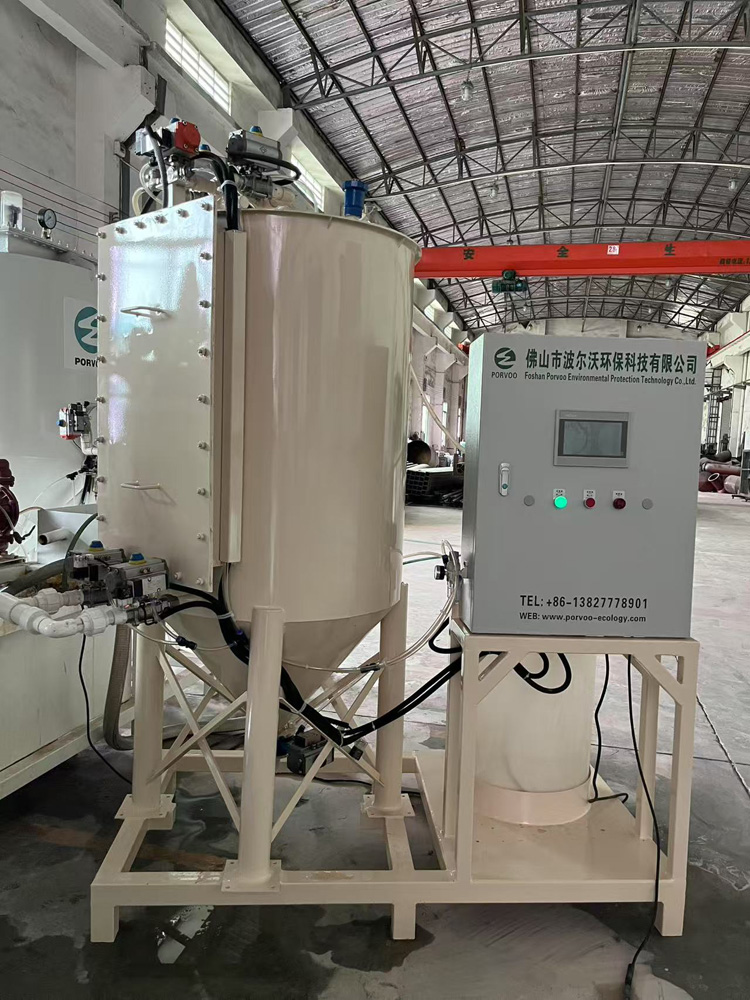
Establish a protocol for routine performance verification and data logging. Document all setpoints, chemical lot numbers, and performance results. This creates a baseline for troubleshooting and demonstrates due diligence for regulatory compliance. Proactive optimization and rigorous documentation prepare the plant not just for efficiency, but for future regulatory scrutiny on metals and other persistent pollutants. For facilities seeking to implement a precise and automated approach, exploring a dedicated automatic polymer dosing system can provide the control consistency required for such a protocol.
Effective ceramic wastewater treatment hinges on mastering the PAC-PAM synergy. Prioritize sequential optimization: first pH for metal removal, then PAC dose for destabilization, and finally PAM for floc formation. Base chemical selection on a detailed waste stream analysis, not generic recommendations. Implement a data-driven protocol that includes floc characterization, as this directly impacts downstream dewatering costs and overall system stability.
Need professional support in designing or optimizing your plant’s coagulation-flocculation process? The chemical engineering team at PORVOO specializes in developing tailored treatment strategies for the ceramic industry, from initial jar testing to full-scale system integration. Contact us to discuss your specific wastewater challenges and treatment objectives. You can also reach our engineering team directly at Bize Ulaşın.
Sıkça Sorulan Sorular
Q: What are the fundamental chemical roles of PAM versus PAC in treating ceramic wastewater?
A: PAC acts as an inorganic coagulant that destabilizes suspended particles by neutralizing their surface charges, while PAM serves as an organic flocculant that bridges these destabilized particles into large, settleable aggregates. This complementary mechanism is essential for the fine, complex particulates in ceramic effluent. For plants dealing with diverse clay and glaze streams, implementing this two-step chemical sequence is critical for effective solid-liquid separation.
Q: How do you optimize pH and dosage when targeting both turbidity and heavy metals?
A: You must treat turbidity reduction and metal removal as separate, sequential optimization problems. Adjust PAC dose primarily to control turbidity via charge neutralization, but dominate metal precipitation by carefully controlling pH, often to acidic conditions below 6. Exceeding the optimal dosage for either chemical risks particle restabilization or creates excessive, difficult-to-handle sludge. This means facilities with mixed glaze waste must prioritize installing precise, automated pH control ahead of coagulant addition.
Q: What key parameters should we test when selecting a PAM type for our ceramic plant?
A: Selection depends on your specific waste stream’s characteristics. For clay-heavy water with large particles, an anionic PAM paired with cationic PAC is often effective. For glaze wastewater containing anionic dispersants, a cationic PAM may be necessary. The GB/T 17514-2017 standard provides the technical requirements for PAM quality. Your pilot testing should evaluate not just floc size but also floc strength and final sludge dewaterability to inform the choice.
Q: Why is a polymerized coagulant like PAC preferred over alum for ceramic wastewater?
A: Polymerized inorganic coagulants like PAC provide more consistent hydrolysis species, leading to reliable performance across variable water temperatures and pH conditions common in ceramic operations. This stability is crucial for effectively treating the diverse particulate mix from different production stages. Facilities seeking process consistency and reduced chemical sensitivity should specify PAC that meets the GB/T 22627-2014 standard for poly aluminum chloride.
Q: What is a systematic protocol for optimizing our coagulation-flocculation process?
A: Begin with comprehensive jar testing across a matrix of pH, PAC dose, and PAM dose, using statistical methods like Response Surface Methodology to model interactions efficiently. The protocol must include steps to characterize floc settleability and shear resistance. Operational implementation requires calibrated chemical feed and pH adjustment systems with regular influent monitoring. Following a structured framework like the HJ 2001-2018 technical specification ensures a disciplined approach that also prepares for regulatory audits.
Q: How should treatment strategy differ for clay slurry versus glaze booth wastewater?
A: For high-solids clay wash water, focus on rapid settling using a standard cationic PAC and anionic PAM. For glaze runoff containing metals and organics, you must first lower pH to around 5.5 to optimize metal precipitation before flocculation, potentially requiring a cationic PAM. This strategic shift moves the goal from just creating settleable flocs to conditioning the slurry for efficient downstream dewatering. Plants with variable waste streams need a programmable dosing system capable of these real-time adjustments.
Q: What are the major operational cost drivers when using PAM and PAC?
A: Total cost is driven by chemical consumption, sludge production, and process stability. While PAC has a lower unit cost, its required dosage is often higher; precise optimization minimizes total chemical use. Overdosing either chemical directly increases sludge volume and handling expenses. For operations aiming to reduce costs, investigate phased dosing strategies during filtration cycles and select the most cost-effective PAM physical form (e.g., emulsion vs. powder) for your preparation system.