For plant managers and process engineers, selecting a dewatering technology is a critical capital decision with decades-long operational consequences. The belt filter press (BFP) is often the default choice for high-volume sludge reduction, yet its performance is frequently misunderstood as a simple mechanical function. The reality is that inconsistent cake solids, high polymer consumption, and premature wear are not inherent flaws of the technology but symptoms of a mismatch between machine design and sludge characteristics. A misapplied BFP becomes a source of continuous operational cost and disposal headaches.
Attention to proper selection and operation has never been more financially urgent. Rising landfill tipping fees, stringent biosolids regulations, and the push for energy recovery from sludge demand predictable, optimized dewatering performance. The belt filter press, when correctly specified and integrated, remains a workhorse for volume reduction. This guide moves beyond basic descriptions to provide a decision framework rooted in sludge science and mechanical engineering, ensuring your investment delivers on throughput, cake dryness, and total lifecycle cost.
How a Belt Filter Press Works: The 3-Zone Dewatering Process
The Gravity Drainage Foundation
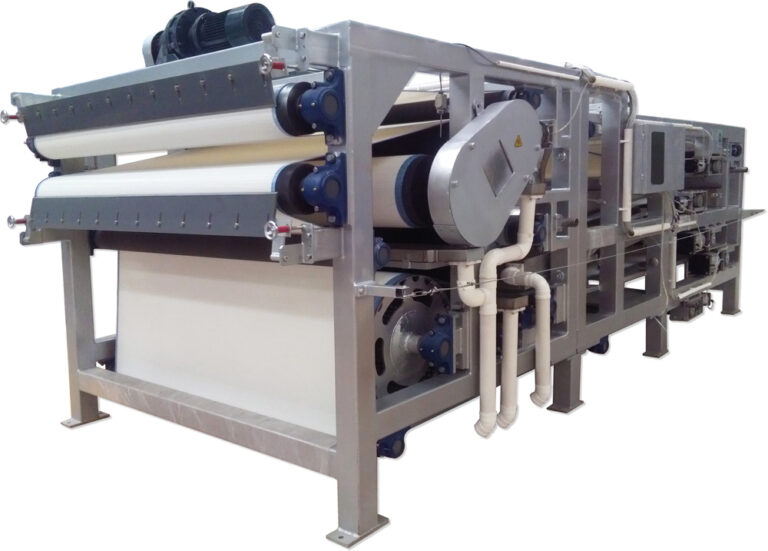
The process begins not with pressure, but with gravity. In this initial zone, chemically conditioned sludge is distributed across the width of a porous belt. Free water drains by gravity alone, with plow systems often used to turn the sludge bed, breaking surface tension and enhancing drainage. This stage is capacity-critical for dilute sludges; if the feed solids are below 1.5%, an insufficient gravity zone will hydraulically overload the subsequent pressure stages, washing out solids and crippling performance. The design length and belt permeability here are the first major vendor differentiators.
Progressive Pressure Application
Following gravity drainage, the sludge enters the wedge zone, where two belts gradually converge. This applies low, increasing pressure and begins to form a coherent cake. The transition to the high-pressure zone is typically marked by a large-diameter primary drum, which is often perforated to allow expressed water to escape without rewetting the forming cake. The sequence of rollers that follows—with diameters progressively decreasing—applies shear and pressure forces. According to research from equipment lifecycle analyses, the engineering of this roller profile, including the use of perforated or “self-bailing” drums, is a key factor in achieving a 2-5% increase in final cake dryness by preventing hydraulic rebound.
The Integrated System Outcome
It’s a mistake to view these zones in isolation. They function as an integrated mechanical system where the output of one stage is the input for the next. A poorly conditioned sludge will not drain effectively in the gravity zone, leading to immediate failure. A wedge zone set too narrow for the sludge compressibility will extrude solids rather than consolidate them. In our comparisons of system layouts, we found that the most reliable performers design each zone as a tuned response to specific sludge rheology, not as a one-size-fits-all conveyor.
Key Design Configurations: Horizontal vs. Vertical & Belt Count
Belt Count: Defining the Process Scope
The choice between a 2-belt and 3-belt system defines the process boundary. A standard 2-belt press requires a consistently thickened feed, typically above 1.5% solids. A 3-belt system incorporates an independent gravity belt thickener (GBT) as its first stage, performing inline thickening before the pressure zones. This is not a minor add-on but a fundamental redesign for dilute feeds. Industry experts recommend the 3-belt configuration for waste activated sludge (WAS) or other thin slurries, as it can reduce the hydraulic load to the press section by 4-10 times, stabilizing feed and dramatically reducing the required polymer dosage and footprint.
Frame Orientation: Footprint vs. Accessibility
The horizontal frame is the industry standard, offering a straightforward layout for belt tracking, maintenance, and cake discharge. The vertical, or “tower,” press stacks the dewatering zones vertically, significantly reducing floor space requirements. While sometimes marketed for a dryness advantage, the primary trade-off is maintenance accessibility. Easily overlooked details include the need for specialized platforms or lifts for routine service on vertical models. The choice often comes down to plant layout constraints and the maintenance philosophy of the operations team.
Matching Configuration to Application Scale
The market segments clearly by scale and need. Smaller, packaged systems often favor simplicity (2-belt, horizontal). Large municipal installations may opt for 3-belt systems to handle variable feeds. Industrial applications targeting maximum dryness for thermal drying or co-processing might select vertical presses. The strategic error is over-engineering—specifying a complex 3-belt system for a stable, well-thickened sludge—which adds capital and maintenance cost without return.
| Konfigürasyon | Birincil Fayda | Typical Application Scale |
|---|---|---|
| 2-Belt System | Standard design | Municipal & industrial |
| 3-Belt System | Integrated thickening | Dilute feeds (<1.5% solids) |
| Horizontal Frame | Common layout | Wide range |
| Vertical “Tower” Press | Smaller footprint | Maximum dryness targets |
| 3-Belt Impact | Performance Gain | Metrik |
| Hydraulic load reduction | 4-10x | Feed stabilization |
| Mass loading increase | Up to 30% | Footprint savings |
Kaynak: Teknik dokümantasyon ve endüstri spesifikasyonları.
Belt Filter Press Performance: Throughput, Cake Dryness & Capture Rate
The Core Performance Triad
Belt filter press performance is quantified by three interdependent metrics: hydraulic loading (GPM/meter), solids capture rate (%), and final cake solids (%). These are not fixed values but a performance envelope dictated by sludge type and machine design. For instance, waste activated sludge is highly variable and compressible, often yielding 15-25% cake solids, while well-digested primary sludge, being more fibrous and stable, can reach 25-40%. The capture rate, typically exceeding 95%, is primarily a function of chemical conditioning and gravity zone efficiency; a drop here signals conditioning failure or hydraulic overload.
The Engineering Drivers of Dryness
Final cake solids are the most critical outcome for disposal cost. This is where pressure zone engineering separates equipment tiers. Designs utilizing a large, perforated primary drum and a specific sequence of progressively smaller rollers are engineered to express water while minimizing cake rewetting. This mechanical design directly impacts the pressure profile and drainage path. Durable construction materials—such as stainless steel frames, hardened rollers, and abrasion-resistant belt scrapers—are not just about longevity; they maintain precise mechanical alignment and tension, which are essential for consistent pressure application and, therefore, consistent cake dryness over the machine’s lifespan.
Interpreting Manufacturer Claims
Vendor performance data sheets provide baseline expectations, but they are generated under ideal, steady-state conditions with a representative sludge. The easily overlooked detail is the assumed feed consistency and polymer program. A machine rated for 40% cake solids with digested sludge may struggle to reach 20% with a poorly conditioned WAS. Pilot testing is the only way to translate brochure metrics into site-specific forecasts for throughput and polymer consumption.
| Çamur Tipi | Typical Cake Solids (%) | Kilit Performans Sürücüsü |
|---|---|---|
| Waste Activated Sludge (WAS) | 15-25% | Floc strength & conditioning |
| Digested Primary Sludge | 25-40% | Sludge compressibility |
| Mixed Sludges | Değişir | Feed consistency |
| Design Impact | Dryness Increase | Özellik |
| Pressure Zone Engineering | +2 to +5% | Prevents cake rewetting |
| Durable Construction | 5-year warranties | Reduces lifecycle cost |
Kaynak: ASTM D8411-22 – Standard Guide for Sludge Dewatering Using Belt Filter Press. This standard provides guidelines for evaluating dewatering performance, including metrics like cake solids and capture rate, which are critical for assessing the operational outcomes detailed in the table.
Operation & Maintenance: Daily Checks, Cleaning, and Optimization
The Non-Negotiable Daily Routine
Consistent performance is impossible without disciplined daily checks. These are not mere inspections but proactive interventions. Key tasks include verifying all spray nozzle patterns for belt cleaning, checking belt alignment and tension to prevent wear and tracking issues, and monitoring bearing temperatures. A single clogged spray nozzle can lead to blinding, which reduces drainage and increases belt wear exponentially. Lubrication schedules must be religiously adhered to, as a failed bearing on a main roller can cause days of downtime.
From Manual Control to System Monitoring
Modern presses are increasingly equipped with Programmable Logic Controllers (PLCs) and SCADA interfaces. This automation handles sequential startup/shutdown, belt tracking corrections, and even basic process control loops. This shifts the operator’s role from constant manual adjustment to system monitoring and data interpretation. The strategic benefit is labor savings and operational consistency, but it demands a higher level of technical competency to troubleshoot the control system itself. The integration of these controls with plant-wide SCADA is now a standard expectation for new installations.
The Levers of Real-Time Optimization
Within the automated framework, key parameters remain for operator adjustment to balance throughput with quality. The wedge zone gap, belt speed, and roller pressure (on adjustable systems) are the primary levers. For example, slowing the belt speed increases residence time in the pressure zone, typically increasing cake dryness but reducing throughput. The move toward data integration enables predictive analytics—tracking motor amperage trends to predict bearing failure or correlating feed solids with optimal polymer dose in real-time.
| Task | Frekans | Parameter Monitored |
|---|---|---|
| Spray nozzle inspection | Günlük | Cleaning efficiency |
| Belt alignment check | Günlük | Tracking & wear |
| Bearing lubrication | As scheduled | Prevent downtime |
| Performance Lever | Adjustment | Balances |
| Wedge zone gap | Manual/automated | Throughput vs. dryness |
| Belt speed | Variable frequency drive | Capacity & cake quality |
| Pressure profile | Roller sequence | Final solids content |
Kaynak: Teknik dokümantasyon ve endüstri spesifikasyonları.
Chemical Conditioning: Polymer Selection and Dosing for Optimal Floc
The Foundation of Mechanical Dewatering
Belt filter presses dewater sludge, not wastewater. Effective chemical conditioning with polymers is the essential step that transforms a slurry into a sludge capable of releasing its water under mechanical pressure. The goal is to form robust, shear-stable flocs that trap fine solids and create permeable channels for water release. Polymer selection—cationic, anionic, or non-ionic—is determined by the sludge’s surface charge and composition. An incorrect polymer type will not form flocs regardless of dose, leading to high solids loss and wet cake.
The Precision of Application
Once the correct polymer is selected, the method of application is equally critical. This involves the preparation (aging) of the polymer solution and its injection and mixing with the sludge. Variable-orifice mixing valves are commonly used to optimize the blend intensity. Too little mixing leaves polymer unreacted; too much shear breaks flocs apart. Industry experts recommend that automation of polymer feed control, tied to feed flow and solids concentration, is no longer a luxury but a necessity for cost control and consistent performance, especially with variable feed streams.
A Strategic Compliance Tool
Beyond performance, conditioning has a strategic regulatory dimension. As disposal regulations tighten, the ability to guarantee a minimum cake solids percentage becomes a compliance issue. Precise, automated polymer dosing is a direct tool for mitigating the risk and cost associated with off-spec material that may be rejected at a landfill or incinerator. It transforms dewatering from a volume-reduction process into a controlled, quality-assured production step.
| Kontrol Parametresi | Etki | Sistem Bileşeni |
|---|---|---|
| Polymer Type | Floc robustness | Selection based on sludge |
| Dosage Accuracy | Capture rate & cost | Automated feed control |
| Mixing Energy | Floc formation | Variable-orifice valves |
| Feed Variation | Dose consistency | PLC integration |
| Sonuç | Stratejik Fayda | Driver |
| Consistent Cake Solids | Disposal compliance | Regulatory pressure |
Kaynak: BS EN 12255-15:2003 – Wastewater treatment plants – Part 15: Measurement of the sludge dewatering capability by the belt press test. This standard’s test method for evaluating dewatering capability directly relates to the need for optimal chemical conditioning to achieve reliable and measurable sludge dewatering performance.
Belt Filter Press Applications: Municipal vs. Industrial Sludge Types
Municipal Sludge Profiles
In municipal wastewater treatment, BFPs handle a range of sludges with distinct behaviors. Primary sludge, rich in settleable solids, is generally easy to dewater. Waste Activated Sludge (WAS) is more challenging due to its fine, biological structure and lower initial solids. Anaerobically digested sludges fall in between, with performance heavily dependent on digester operation. The key is recognizing that a plant’s sludge blend changes daily; the dewatering system must be robust enough to handle this variability, often necessitating a flexible polymer program and sometimes a 3-belt design for thin WAS streams.
Industrial Process Challenges
Industrial applications present a wider, often more abrasive, spectrum. Pulp and paper sludges can be fibrous but voluminous. Food processing wastes may be high in fats or sugars. Mineral and mining slurries are abrasive and dense. Petrochemical sludges may contain hydrocarbons that affect polymer performance. Each type has unique drainability and compressibility characteristics that must be matched to the press’s zone design. For example, an abrasive mineral slurry demands a press built with exceptional wear protection on all contact surfaces.
The Rise of Flexible Deployment
A significant trend is the growing availability of rental and skid-mounted, mobile belt filter press systems. This offers a lower-capital-risk solution for seasonal operations, plant upgrades during construction, or remote sites. It also creates a competitive aftermarket for temporary processing capacity, allowing smaller operators or project-based teams to access professional dewatering without a major capital commitment. This reflects a broader shift toward more agile, decentralized infrastructure planning.
Advantages and Limitations Compared to Other Dewatering Methods
The BFP Value Proposition
The belt filter press excels at continuous, high-throughput volume reduction with relatively low energy consumption compared to thermal dryers. It produces a conveyable, stackable cake suitable for landfill, land application, or further processing. Its operational simplicity and continuous nature make it ideal for large, steady streams of sludge. It is the workhorse technology where the primary goal is reliable mass reduction, not ultimate dryness.
Inherent Constraints and Sensitivities
The limitations are significant and dictate its place in the technology matrix. Performance is intrinsically tied to chemical conditioning; a polymer system failure immediately halts effective dewatering. It is sensitive to feed variations in solids concentration and composition. The cake produced, while handleable, is typically less dry than that from a recessed chamber plate press or a centrifuge, and far wetter than from thermal drying. It also requires more operator attention for belt maintenance and washing than a fully enclosed centrifuge.
Positioning in the Technology Portfolio
This positions the BFP as a mid-range solution on the spectrum of dewatering intensity and cost. It is less capital-intensive than a centrifuge and far less energy-intensive than a thermal dryer. The trend toward vendor consolidation means many suppliers now offer the BFP as part of a packaged “dewatering center” including feed pumps, polymer systems, and conveyors. This simplifies procurement but requires buyers to critically assess whether the bundled components represent best-in-class value for their specific application or a convenience premium.
Selecting and Sizing a Belt Filter Press: A 5-Step Decision Framework
From Sludge Analysis to Performance Goals
The selection process must be systematic, starting with a thorough sludge characterization. This includes measuring feed solids concentration, conducting drainability tests (like capillary suction time), and assessing compressibility. These properties are immutable inputs that dictate machine design. Step two is to define clear, quantifiable performance goals: target cake solids percentage, minimum capture rate, and required daily dry solids throughput. These goals must balance operational needs with disposal economics.
Configuration Selection and Preliminary Sizing
With sludge data and goals defined, step three is selecting the configuration: horizontal vs. vertical, 2-belt vs. 3-belt. This decision is guided by footprint, feed consistency, and target dryness. Step four involves preliminary sizing using industry-standard loading rates. Hydraulic loading (gallons per minute per meter of belt width) and solids loading (dry tons per hour per meter) provide an initial belt width estimate, typically ranging from 0.5 to over 3 meters. This is where consulting technical data for specific belt filter press models is essential to match vendor capabilities to your calculated loads.
The Critical Validation Step
Brochure sizing is only an estimate. Step five—pilot testing with representative sludge—is non-negotiable for any significant investment. A well-run pilot test confirms the achievable cake solids, optimizes polymer type and dose, and validates hydraulic and solids loading rates for the specific equipment design. It de-risks the capital purchase by providing real-world data for performance guarantees. Skipping this step is the most common and costly error in the procurement process.
| Adım | Anahtar Eylem | Quantitative Metric/Range |
|---|---|---|
| 1. Characterize Sludge | Analyze drainability | Feed solids concentration |
| 2. Define Goals | Set cake solids target | e.g., 20-40% |
| 3. Select Configuration | Choose belt count | 2-belt vs. 3-belt |
| 4. Preliminary Sizing | Use loading rates | Belt width: 0.5–3+ m |
| 5. Validate | Pilot test | Confirm polymer dose |
Kaynak: ISO 18414:2015 – Belt filter press dewatering equipment. This standard outlines equipment design and performance parameters, providing a foundational basis for the systematic selection and sizing process described in the framework.
Successful belt filter press implementation hinges on three decisions: rigorously characterizing your sludge’s drainability and compressibility, selecting a machine configuration whose design directly addresses those characteristics, and committing to a pilot test for vendor validation. This disciplined approach aligns the mechanical process with your sludge science, ensuring the system meets targets for throughput, cake dryness, and operational cost.
Need professional guidance to specify or optimize your dewatering system? The engineers at PORVOO combine application expertise with a comprehensive range of dewatering technologies to deliver solutions matched to your specific sludge profile and plant objectives. Contact our technical team to discuss your project requirements. Bize Ulaşın
Sıkça Sorulan Sorular
Q: How does the design of the pressure zone impact final cake dryness in a belt filter press?
A: The engineering of the pressure zone directly determines moisture removal efficiency. Designs that incorporate large initial drums, specific sequences of rollers, and perforated self-bailing drums are critical to prevent rewetting of the cake. These mechanical features can increase final solids content by 2-5% compared to simpler designs. For projects where maximum dryness is a key cost driver, you should prioritize evaluating the specific pressure zone configuration during vendor selection.
Q: When should we consider a three-belt press over a standard two-belt configuration?
A: A three-belt system is optimal for dilute sludge feeds below 1.5% solids, as it integrates an independent gravity belt thickener. This design performs preliminary thickening before the pressure zones, stabilizing feed and reducing hydraulic load by 4 to 10 times. It can also increase mass loading by about 30%. This means facilities with consistently thin sludge should evaluate this configuration for its potential footprint and polymer savings, despite a higher initial cost.
Q: What operational data should we monitor daily to optimize belt press performance?
A: Key performance parameters include feed solids concentration, hydraulic loading rate, polymer dosage, final cake solids percentage, and solids capture rate. Modern systems use Programmable Logic Controllers (PLC) and SCADA interfaces to automate control and data collection. This automation shifts the operator role to monitoring and analysis. If your operation experiences feed variability, plan for integrated control systems to maintain consistent dewatering and enable predictive maintenance.
Q: How do industry standards guide the evaluation of sludge for belt press dewatering?
A: Standards provide formalized test methods to assess sludge characteristics critical for sizing. BS EN 12255-15:2003 specifies a belt press test to measure dewatering capability, informing design and performance expectations. Furthermore, equipment design and performance parameters are outlined in ISO 18414:2015. This means you should use standardized testing with representative sludge during the selection process to validate vendor claims and ensure the chosen press meets your specific goals.
Q: What is the critical role of polymer conditioning in belt filter press operation?
A: Effective polymer conditioning is essential to form robust flocs that readily release water, and performance is highly sensitive to correct type, dose, and mixing. Automating polymer feed control is critical for responding to feed variations and maintaining optimal dosage. As regulatory scrutiny on biosolids disposal increases, consistent conditioning becomes a compliance strategy. For operations targeting stable, regulatable cake solids, you must budget for and prioritize advanced polymer dosing and control systems.
Q: What are the key steps for correctly sizing a belt filter press for a new application?
A: Follow a structured five-step framework: first, characterize sludge drainability and compressibility; second, define target cake solids and throughput; third, select configuration (e.g., horizontal/vertical, belt count); fourth, perform preliminary sizing using hydraulic and solids loading rates; fifth, validate all assumptions with pilot testing. The ASTM D8411-22 guide covers operational procedures for such evaluation. This process ensures your selected machine aligns with both technical specifications and long-term operational cost targets.
Q: How does the trend toward vendor consolidation affect procurement of a dewatering system?
A: Many vendors now offer integrated solutions including feed systems, polymers, and conveyors alongside the press itself. This simplifies procurement and can ensure component compatibility from a single-source partner. However, it may limit the ability to select best-in-breed components for each subsystem. For projects where specific performance or cost parameters are paramount, you should weigh the convenience of a bundled solution against the potential benefits of a multi-vendor approach.