Para os proprietários de marcenarias e gerentes de produção, especificar o CFM correto para uma mesa de lixamento 2×3 downdraft é uma decisão técnica crítica. O erro comum é presumir que um aspirador de pó padrão fornece fluxo de ar suficiente, o que leva à captura ineficaz de poeira e ao comprometimento da qualidade do ar. Esse erro faz com que as partículas finas permaneçam no ar, representando riscos à saúde e contaminando os acabamentos.
Compreender os requisitos precisos de fluxo de ar é essencial para a conformidade com os padrões modernos de segurança e para proteger a eficiência operacional a longo prazo. Um sistema devidamente especificado afeta diretamente a saúde do trabalhador, a limpeza da oficina e a qualidade do produto final, o que o torna um investimento fundamental para qualquer ambiente profissional de marcenaria.
Requisitos principais de CFM para uma mesa de lixamento Downdraft 2×3
Definição da velocidade de captura efetiva
A captura eficaz de poeira é definida pela obtenção de velocidade de ar suficiente em toda a superfície de trabalho de seis pés quadrados. As referências do setor convergem para um requisito de 350 a 400 CFM. Essa faixa é validada por unidades comerciais, que geralmente especificam uma classificação de 350 CFM alimentada por um motor de 1/3 HP. Um aspirador de loja padrão, normalmente classificado entre 100 e 150 CFM, falha porque seu fluxo de ar se torna muito diluído na área da mesa, incapaz de capturar a poeira fina na fonte antes que ela se espalhe pelo ar.
O benchmark e seu contexto
Esse CFM alvo garante que o downdraft possa superar as portas dedicadas em ferramentas como lixadeiras orbitais aleatórias e de cinta, fornecendo uma solução de captura universal. Embora 350-400 CFM seja um ponto de partida robusto, a necessidade exata depende do contexto. Ela varia de acordo com a combinação de ferramentas específicas, o grão da mídia de lixamento e a intensidade operacional. As oficinas que realizam sessões de lixamento contínuas e agressivas talvez precisem visar o limite superior dessa faixa para manter uma velocidade de face consistente sob cobertura variável da peça de trabalho.
A tabela a seguir descreve as principais especificações para um desempenho eficaz.
Especificações de componentes para desempenho
| Componente | Especificação / Requisito | Justificativa principal |
|---|---|---|
| Tamanho da tabela | 2 pés x 3 pés (6 pés quadrados) | Área de superfície de trabalho padrão |
| Faixa de CFM alvo | 350 - 400 CFM | Referência do setor para captura |
| Motor típico | 1/3 HP | Alimenta unidades comerciais de forma eficaz |
| Aspirador de pó (inadequado) | 100 - 150 CFM | Fluxo de ar diluído, falha na captura |
Fonte: Documentação técnica e especificações do setor.
Em nossa análise das ofertas comerciais, descobrimos que as unidades que atendem a essa especificação de CFM relataram consistentemente taxas de captura superiores para poeira fina, impactando diretamente as leituras de qualidade do ar da loja.
Principais fatores que determinam o CFM necessário
Pressão estática e resistência do filtro
O requisito principal de CFM é apenas o começo. O soprador deve superar uma pressão estática significativa criada pelo filtro, um desafio que os aspiradores de pó padrão não conseguem enfrentar, apesar de sua alta pressão nominal. Um filtro fino necessário para a proteção da saúde acrescenta uma resistência substancial. O soprador do sistema deve ser classificado para fornecer o CFM desejado com essa pressão estática utilizável, não apenas com ar livre.
Interferência da peça de trabalho e design da grade
A cobertura da peça de trabalho representa um grande desafio de projeto. Uma porta ou painel de gabinete grande pode bloquear a maioria das perfurações da mesa, reduzindo drasticamente a sucção localizada. Isso exige que o sistema seja projetado para a inteira área aberta da mesa para manter a velocidade mesmo quando parcialmente bloqueada. O projeto da grade da mesa - seu padrão de orifícios, tamanho e porcentagem da área aberta total - deve ser precisamente equilibrado com a saída do soprador. Uma grade excessivamente porosa pode reduzir a velocidade de sucção, enquanto uma grade restritiva sobrecarrega o soprador.
O projeto eficaz afeta diretamente a eficiência da sucção. Isso requer uma engenharia cuidadosa da parte superior e do plenum interno para manter a velocidade da face para diferentes tamanhos de peças, geralmente por meio de padrões estratégicos de furos ou sucção perimetral suplementar.
A interação desses fatores determina o desempenho no mundo real.
Determinantes do desempenho do sistema
| Fator | Impacto no sistema | Considerações sobre o design |
|---|---|---|
| Pressão estática | Deve superar a resistência do filtro | Crítico para a captura de poeira fina |
| Cobertura da peça de trabalho | Bloqueia as perfurações e reduz a sucção | Projeto para toda a área aberta |
| Área aberta da grade % | Equilibra com a saída do soprador | Mantém a velocidade da face |
| Projeto do Plenum | Gerenciamento do fluxo de ar interno | Requer costuras herméticas |
Fonte: Documentação técnica e especificações do setor.
Unidade autônoma vs. conexão do coletor de pó central
O caso de um sistema dedicado
Para muitas lojas de armários, uma unidade dedicada e autônoma com seu próprio soprador e filtro de aproximadamente 1 HP é a opção operacionalmente eficiente. Ela permite uma operação rápida e silenciosa durante as tarefas de lixamento intermitente, sem a necessidade de um sistema central grande e que consome muita energia. Essa decisão geralmente é motivada pelo ritmo de trabalho; para oficinas com sessões de lixamento curtas e frequentes, uma unidade dedicada reduz o desgaste mecânico de um coletor grande, diminui a poluição sonora e elimina o desperdício de energia de um equipamento superdimensionado para uma única estação.
Quando a conexão central faz sentido
A conexão de uma mesa de sucção descendente a um coletor de pó central é potente, mas frequentemente exagerada. Embora simplifique a infraestrutura por ter um único sistema para manutenção, pode entupir rapidamente os filtros principais com poeira fina de acabamento. Isso é ineficiente para o uso intermitente e pode violar as práticas recomendadas de gerenciamento de filtros ao misturar partículas muito finas com resíduos mais grossos da oficina. No entanto, para uma oficina com uma mesa fixa em uso constante e um sistema central dimensionado corretamente para a carga adicional, essa pode ser uma opção viável.
Choosing the Right Blower and Filter for Your System
Blower Selection Beyond CFM
Selecting components requires looking beyond a single CFM number. The blower must be rated for the required CFM at a usable static pressure—typically a centrifugal (squirrel cage) blower from HVAC or a dedicated dust collector motor. These are engineered for sustained performance against resistance, unlike a shop vacuum motor which is designed for high pressure but low volume in a confined hose. The motor must match the load; a 1 HP motor is common for a dedicated unit delivering 350-400 CFM through a fine filter.
Filter Quality as a Safety Determinant
Filter quality is the paramount safety determinant. The system is only as effective as its filter; capturing hazardous sub-micron particles requires a filter rated for at least 1 micron, with true HEPA or MERV 15+ being the standard for health protection. Pair this with ample filter area (e.g., 230 sq. ft.) to minimize cleaning cycles and maintain stable airflow. This combination ensures the system protects long-term operator health by preventing silica and other fine particulates from recirculating, not just keeping the shop clean.
The specifications for health and performance are non-negotiable.
Critical Component Specifications
| Componente | Especificação crítica | Health & Safety Rationale |
|---|---|---|
| Blower Type | Centrifugal (squirrel cage) | Rated for CFM at static pressure |
| Filter Rating | 1 micron or finer (HEPA/MERV 15+) | Captures hazardous sub-micron particles |
| Filter Area | e.g., 230 sq ft | Minimizes cleaning, maintains airflow |
| Potência do motor | ~1 HP for dedicated unit | Matches 350-400 CFM requirement |
Fonte: Documentação técnica e especificações do setor.
Practical Design Tips to Maximize Dust Capture
Combating Workpiece Blockage
To combat the inherent problem of workpiece blockage, incorporate a secondary perimeter suction slot. This provides an alternate capture path when the main grid is covered. Alternatively, use a movable suction scoop or a smaller auxiliary table that can be placed directly adjacent to the active sanding area on a large panel. Ensuring all internal seams in the plenum are airtight with silicone or gasketing is critical; any leakage drastically reduces effective suction at the tabletop by providing a path of less resistance for the airflow.
Material and Customization
The choice of grid material—perforated hardboard or steel—should balance durability with open area percentage. Steel offers longevity but requires precise fabrication. A growing ecosystem of modular solutions exists. Shops can now use on-demand fabrication services to create custom hold-downs, airflow baffles, or adapter shrouds for specific tools, tailoring the table to their exact processes for optimal performance beyond the off-the-shelf configuration.
Calculating the True Cost of Ownership and Operation
Além do preço de compra
The initial purchase or build cost is just one component. True cost includes operational energy consumption, which favors a dedicated, correctly sized system over frequently cycling a large central collector. Filter replacement is a recurring cost dictated by filter quality and shop volume; a cheaper filter that clogs quickly or passes fine dust creates higher long-term cost and liability. Maintenance labor for emptying bins and cleaning filters must also be factored into operational overhead.
Evaluating Total ROI
The market spectrum ranges from DIY builds to industrial units exceeding $1,000, highlighting that defining duty cycle and compliance needs is essential to avoid under-specification or costly over-engineering. Evaluating ROI requires broader metrics: gains in finish quality from a dust-free environment, worker efficiency from reduced masking and cleanup, and decreased absenteeism from better air quality. This positions the downdraft table as a productivity and quality assurance station, not just a utility.
A comprehensive cost analysis informs better investment decisions.
Total Cost of Ownership Breakdown
| Componente de custo | Range / Consideration | Impact on ROI |
|---|---|---|
| Initial Purchase | DIY to >$1,000 industrial | Define duty cycle needs |
| Energia operacional | Dedicated vs. central system | Favors correctly sized unit |
| Substituição do filtro | Recurring, based on volume | Dictated by filter quality |
| ROI Metrics | Finish quality, worker efficiency | Positions as productivity station |
Fonte: Documentação técnica e especificações do setor.
Essential Safety and Maintenance Considerations for Longevity
Compliance and Health Protection
A primary safety requirement is the filter’s ability to capture fine particulate to prevent respiratory hazards. This aligns with increasing regulatory focus on silica dust and insurance requirements, which will mandate professional-grade, certified solutions for commercial shops. Proactive investment in a proper system is a strategic risk mitigation move. Compliance with standards like NFPA 664-2020 for fire and explosion prevention is non-negotiable in a professional setting, governing the safe design and operation of all dust collection components.
Routine Maintenance Protocol
Safety and maintenance are inseparable. Regular maintenance is non-negotiable: empty collection bins before they overflow to maintain airflow and prevent backpressure that strains the motor. Clean or replace filters based on pressure drop monitoring, not a set schedule. Ensure all electrical components, including the blower motor and any table lighting, are properly grounded, especially in a dust-laden environment where static discharge poses a fire risk.
Adherence to established standards forms the backbone of a safe shop.
Safety and Maintenance Requirements
| Requisito | Action / Standard | Consequence of Neglect |
|---|---|---|
| Fine Particulate Capture | HEPA or MERV 15+ filter | Prevents respiratory hazards |
| Regular Maintenance | Empty bin, clean filter | Maintains system airflow |
| Conformidade regulatória | NFPA 664, silica dust rules | Mandates certified solutions |
| Electrical Safety | Proper grounding in dust | Prevents fire/explosion risk |
Fonte: NFPA 664-2020. This standard sets requirements for fire and explosion prevention in woodworking facilities, directly governing the safe design and operation of dust collection systems to mitigate combustible wood dust hazards.
How to Verify Your System’s Performance and Make Adjustments
Simple Field Verification Methods
Verification ensures your theoretical CFM translates to practical capture. Without advanced tools, perform a simple test: hold a thin plastic shaving or piece of tissue near the table surface. It should be pulled firmly and consistently against the grid across the work area. If capture is weak or uneven, first check for air leaks in the ducting connections or plenum seams using smoke or a listening device. Second, assess if the filter is clogged by checking the blower’s output or monitoring static pressure.
Performance Tuning and Adjustments
For performance tuning, partially covering unused grid sections with a board or baffle can increase suction velocity in the active working zone by reducing the total open area the blower serves. This is a practical method for working on smaller parts. Looking forward, smart systems with automated airflow control are emerging. Today, shops can seek units with Variable Frequency Drives (VFDs) to manually adjust blower speed for different tasks or workpiece coverage, optimizing performance and energy use in real-time.
Practical tests and tuning are required for optimal setup.
Performance Verification and Tuning
| Verification Method | Indicator of Performance | Tuning Action |
|---|---|---|
| Tissue/Shaving Test | Pulled firmly to grid | Confirms adequate suction |
| Check for Air Leaks | In ducting or plenum | Sealing improves velocity |
| Monitor Filter Clogging | Increased pressure drop | Clean or replace filter |
| Partial Grid Coverage | Increases local velocity | Optimize for workpiece size |
Fonte: Documentação técnica e especificações do setor.
Begin by validating your system meets the 350-400 CFM benchmark with a dedicated blower capable of overcoming filter pressure. Then, ensure your filter specification meets health standards, not just dust collection needs. Finally, integrate performance verification into your weekly maintenance routine to catch issues before they impact air quality or efficiency.
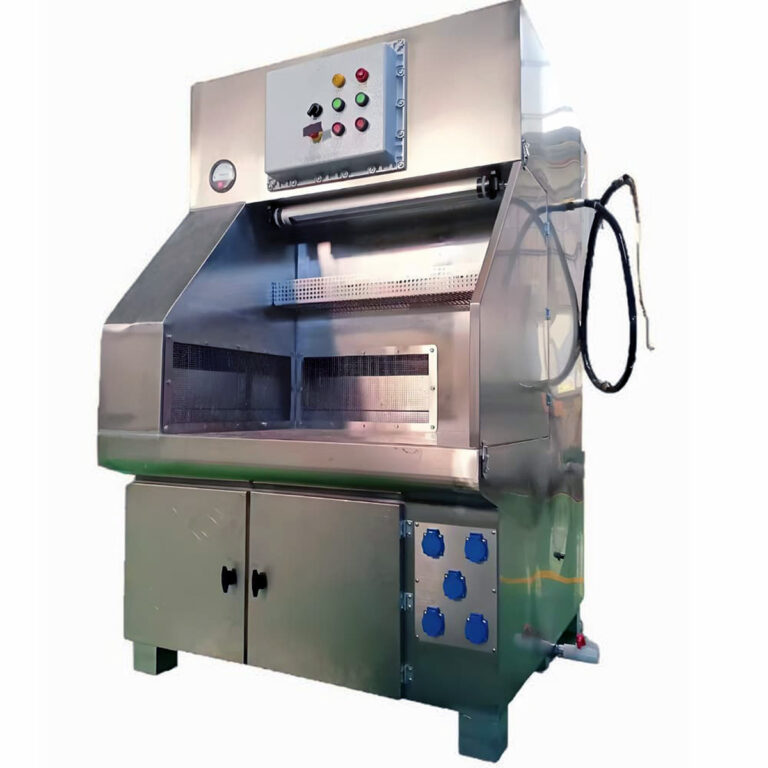
For a professionally engineered solution that balances airflow, filtration, and safety compliance, evaluate purpose-built systems like a commercial downdraft sanding table. Need a system configured for your shop’s specific workflow and volume? The engineering team at PORVOO can provide a detailed analysis.
For further discussion on your application, you can also Entre em contato conosco.
Perguntas frequentes
Q: What is the baseline CFM requirement for a 2×3 downdraft sanding table, and why is a shop vacuum insufficient?
A: A 2×3-foot table requires 350 to 400 CFM to generate sufficient air velocity across its six-square-foot surface for effective fine dust capture. Commercial units confirm this, often using a 1/3 HP motor to achieve 350 CFM. A standard shop vacuum, delivering only 100-150 CFM, cannot overcome system resistance or maintain velocity, leading to poor capture. This means shops should use this CFM range as a minimum starting point for system design, not a target for a vacuum.
Q: How does connecting a downdraft table to a central dust collector compare to using a dedicated unit?
A: A dedicated, self-contained unit with its own ~1 HP blower and filter is operationally superior for intermittent sanding tasks, as it avoids cycling a large, energy-intensive central system. Tying into a central collector can be powerful but is often inefficient for short sessions and risks quickly clogging main filters with fine particulate. For shops with frequent, short sanding sessions, a dedicated unit minimizes energy waste, system wear, and noise.
Q: What filter specification is critical for protecting worker health in a downdraft table system?
A: Filter quality is the paramount safety determinant, as the system must capture hazardous sub-micron particles. You need a filter rated for at least 1 micron, with true HEPA or a MERV 15+ rating being the standard for health protection. Pair this with ample filter surface area to reduce cleaning frequency. If your operation involves sanding wood, plan for a filter that meets this standard to mitigate respiratory risks and align with growing regulatory focus on silica dust.
Q: What practical design adjustments can improve dust capture when a large workpiece blocks the table grid?
A: To combat suction loss from workpiece coverage, incorporate a secondary perimeter suction slot or use a movable suction scoop positioned near the active sanding zone. You can also temporarily cover unused grid sections with a board to increase localized air velocity. Ensuring all internal plenum seams are airtight is foundational to maintaining suction power. This means shops should design for flexibility, using modular solutions to adapt suction to the specific workpiece being processed.
Q: Beyond purchase price, what are the key factors in calculating total cost of ownership for a downdraft system?
A: True cost includes operational energy use, which favors a correctly sized dedicated system over frequently cycling a large central collector, and recurring filter replacement expenses. You must also evaluate return on investment through gains in finish quality, worker efficiency, and reduced cleanup time. For projects where compliance and daily use are priorities, plan for a professional-grade system to avoid the hidden costs of under-specification or excessive maintenance.
Q: How can I verify my downdraft table’s performance and tune it without specialized equipment?
A: Conduct a simple performance test by holding a thin plastic shaving or tissue near the table surface; it should be pulled firmly against the grid. Weak capture indicates potential air leaks in the ducting or plenum, or a clogged filter. For tuning, partially covering unused grid sections can increase suction velocity in the work zone. If your system performance is inconsistent, first methodically check for air leaks before considering component upgrades.
Q: What fire safety standard applies to dust collection systems in a professional cabinet shop?
A: Woodworking dust collection systems, including downdraft tables, must address fire and explosion hazards from combustible wood dust. The relevant standard is NFPA 664-2020, which provides requirements for prevention and protection in wood processing facilities. This means commercial shops should ensure their system design, filter selection, and maintenance protocols help meet the intent of this standard to mitigate insurance and regulatory risks.