In industrial finishing operations, fine particulate poses a persistent challenge. It compromises air quality, reduces visibility, and creates significant health and safety liabilities. Professionals often underestimate the complexity of effective source capture, assuming any vacuum-equipped table will suffice. This misconception leads to underperforming systems that fail to meet compliance standards or protect personnel.
The need for engineered dust control is more critical than ever. Regulatory scrutiny on air quality and combustible dust is intensifying, while the cost of non-compliance—both in fines and health claims—continues to rise. Selecting the right downdraft sanding table is not a matter of convenience but a strategic decision impacting operational safety, productivity, and long-term liability.
How Does a Downdraft Sanding Table Work?
The Core Principle of Source Capture
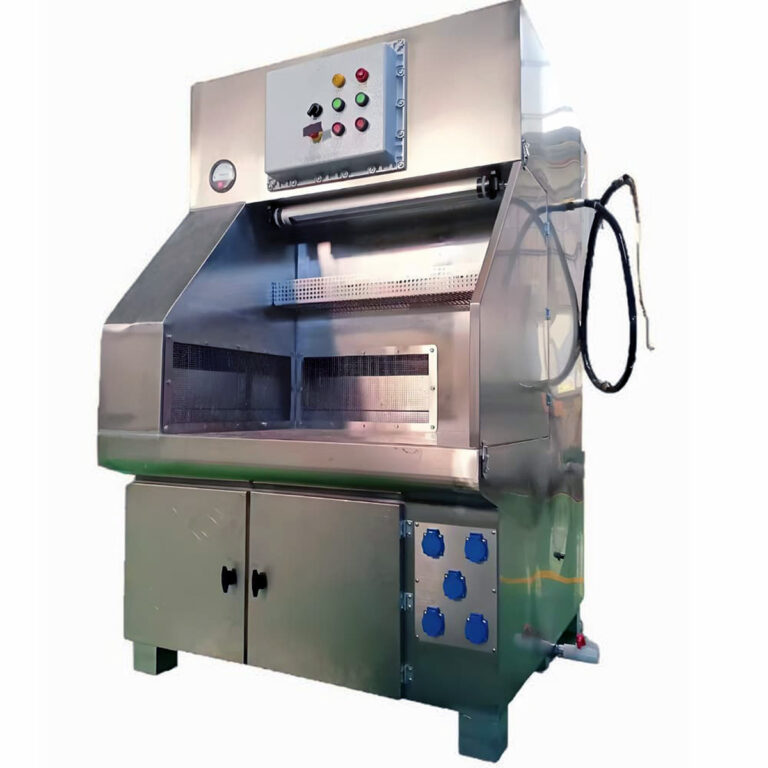
A downdraft table is a local exhaust ventilation (LEV) system engineered for source capture. It creates a controlled downward airflow through a perforated work surface, pulling dust and fumes away from the operator’s breathing zone and into a sealed plenum below. This direct capture method is far more effective than general room ventilation for controlling fine, airborne particulates generated by sanding, grinding, or polishing. The goal is to intercept contaminants before they become ambient, a principle central to industrial hygiene.
Aerodynamic Design Over Raw Power
Effectiveness hinges on aerodynamic design, not just vacuum strength. A common bottleneck is mismatched airflow paths. The total open area of the tabletop perforations must meet or exceed the cross-sectional area of the exhaust duct to prevent restriction. For a standard 4-inch duct, this requires approximately 12.56 square inches of open area, dictating precise hole patterning. Furthermore, the internal plenum must be perfectly sealed and often sloped; any leak drastically reduces capture velocity across the entire surface, rendering the system ineffective. In my experience evaluating systems, seal integrity is the most frequently overlooked yet critical performance metric.
Integration into a Broader Strategy
It is crucial to understand that a downdraft table is a component within a layered dust control strategy. It excels at capturing fine, airborne dust but is ineffective for primary capture of large, ejected chips from operations like milling or drilling. Therefore, it should complement—not replace—point-of-operation extraction at tools. A holistic facility plan layers source capture (downdraft tables, extraction arms) with ambient air filtration for comprehensive protection, a approach supported by ventilation standards like ANSI/ASSP Z9.5-2022.
Key Technical Specifications for Optimal Performance
Understanding Airflow and Velocity
The primary performance metrics are airflow (CFM) and capture velocity. The connected dust collector must provide sufficient CFM to maintain an air velocity of 100-200 feet per minute across the entire table surface. This velocity range is necessary to overcome thermal and cross-drafts in the workspace and ensure particulate capture. Motor power, often starting around 1 HP, supports this requirement, but the system’s design dictates how efficiently that power is converted into effective airflow. Simply selecting a collector based on motor horsepower alone is a common error.
The Critical Role of Filtration
Filter efficiency is a non-negotiable specification for health and safety. Industrial systems use multi-stage filtration: a primary bag or cyclone for coarse debris and a final filter capable of capturing sub-micron particulates. For hazardous dusts, a HEPA or equivalent filter capturing particles down to 0.5 microns is often mandated. The performance gap between a basic filter and a HEPA-grade filter represents the difference between visible dust control and true health protection.
The Cost-Performance Spectrum
Specifications reveal a stark trade-off. The market spans from sub-$200 DIY solutions to commercial units priced from $4,000 to over €26,000. This spectrum caters to different risk profiles. Commercial solutions are engineered assets that mitigate regulatory liability and health claims, justifying their cost through reduced operational risk and total cost of ownership, not just features.
The following table outlines the key technical parameters that define system performance and cost.
| Parameter | Typical Range / Specification | Key Consideration |
|---|---|---|
| Airflow (CFM) | Varies by table size | Must maintain 100-200 FPM |
| Capture Velocity | 100-200 feet per minute | Across entire table surface |
| Motor Power | ~1 HP (13A at 110V) | Supports required CFM |
| Filter Efficiency | Down to 0.5 microns | HEPA/cartridge final filter |
| Price Range (Commercial) | $4,000 to €26,000+ | Reflects compliance, durability |
Source: ANSI/ASSP Z9.5-2022: Laboratory Ventilation. This standard provides the authoritative framework for designing local exhaust ventilation (LEV) systems, establishing minimum requirements for airflow and performance to protect personnel from airborne contaminants like sanding dust.
Choosing the Right Size and Tabletop Design
Matching Dimensions to Operational Scale
The table’s physical footprint must align with workflow. Working areas range from approximately 48″x31″ for single-operator tasks to over 91″x183″ for large components like cabinet doors or metal panels. Standard table height is typically 34″-36″ for ergonomic standing work. A common mistake is selecting a table too small for the typical workpiece, forcing operators to work over the edge where capture efficiency plummets.
Tabletop Configuration and Its Impact
The tabletop design directly dictates performance. Perforated steel or aluminum and pegboard are common, with hole size and pattern being critical. Smaller holes (e.g., 1/4″) provide more distributed suction ideal for fine dust, while larger slots (3/4″) accommodate bigger debris but may reduce overall capture velocity if not properly calculated. The material choice also affects durability; metalworking applications demand spark-resistant, heavy-gauge steel.
Strategic Features for Lifecycle Value
Design choices extend beyond capture to serviceability and flexibility. A removable top panel is not a convenience but a critical feature for maintaining internal components and ensuring uptime. Integrated utility trays, electrical outlets, and heavy-duty locking casters transform a static tool into a flexible workstation. These are strategic investments that reduce long-term operational friction. I’ve observed that shops prioritizing easy maintenance in their purchase criteria experience significantly lower lifecycle costs.
Selecting the correct physical configuration requires balancing several factors, as detailed below.
| Feature | Common Options / Dimensions | Primary Impact |
|---|---|---|
| Work Surface Area | 48″x31″ to 91″x183″ | Fits single or large parts |
| Table Height | 34″-36″ | Operator ergonomics |
| Tabletop Hole Size | 1/4″ to 3/4″ | Fine dust vs. large debris |
| Tabletop Material | Perforated steel, pegboard | Durability, airflow pattern |
| Key Design Features | Removable top, casters | Serviceability, mobility |
Source: Technical documentation and industry specifications.
Integrating with Your Dust Collection System
Ensuring Compatible Airflow Capacity
Proper integration is foundational. The downdraft table must be connected to a dust collector with adequate CFM capacity for its size. A modest table may function with a high-performance shop vacuum, but larger industrial tables require a dedicated collector. The critical step is verifying the collector’s CFM rating at the expected static pressure of the fully assembled system—hose, filters, and table. An undersized collector will not achieve the necessary capture velocity.
Achieving and Maintaining Airtight Connections
Performance leaks occur at connections. The junction between the table’s dust port and the collector hose must be absolutely airtight, often requiring silicone caulk or a gasketed clamp. This highlights a future trend toward smart, connected systems that monitor pressure drop and filter status in real time, evolving the table from a passive tool into an active environmental control node. For facilities managing multiple stations, exploring a centralized industrial downdraft workbench system can provide a scalable and efficient solution.
Ductwork Design and System Balance
If connecting to a central collection system, ductwork design becomes paramount. Use smooth-walled metal ducting where possible, minimize bends, and ensure the branch serving the table is properly balanced with other system inlets. An unbalanced system will starve the downdraft table of airflow. Remember, the table is the terminal point; its performance is only as good as the system feeding it.
Downdraft Tables for Metalworking vs. Woodworking
Contaminant-Driven Design Divergence
Application dictates fundamental design differences. For woodworking and composites, tables capture light, combustible dust. Metalworking and welding generate heavy, abrasive particulates, sparks, and toxic fumes. This divergence makes a universal table impractical. “Metal Capture” systems are built with spark-resistant materials, heavier-gauge construction, and filters designed for higher-density dust, often incorporating spark arrestors pre-filter.
Compliance and Cost Implications
This segmentation has direct cost implications. Systems engineered for metalworking command a significant price premium due to the specialized materials, safety features, and often more robust filtration stages required. For example, a system rated for capturing welding fume and abrasive grit may be priced at €26,729, reflecting its engineered value in risk mitigation. Using a woodworking table for metal applications voids safety certifications and creates serious liability.
The table below clarifies the key distinctions between systems designed for different industrial applications.
| Application | Primary Contaminant | Key Design & Cost Difference |
|---|---|---|
| Woodworking/Composites | Light, combustible dust | Standard construction |
| Metalworking/Welding | Heavy, abrasive particulates | Spark-resistant materials |
| Metalworking/Welding | Sparks, fumes | Heavy-duty filters |
| Price Example (Metal) | €26,729 | Significant price premium |
Source: Technical documentation and industry specifications.
Strategic Product Development
This cross-industry need drives manufacturers toward scalable, modular platform designs. Core systems are adapted with specialized filters, tops, and accessories for markets from aerospace composites to structural steel fabrication. This approach allows for economies of scale while meeting the distinct technical and regulatory requirements of each sector.
Maintenance, Filter Efficiency, and Operational Costs
The Filter Lifecycle and Performance Decay
Long-term performance is dictated by maintenance. The primary operational challenge is maintaining consistent suction as filters load with particulate. A clogged filter increases static pressure, reducing airflow and capture velocity at the table surface. A regular, documented schedule for inspecting, cleaning, and replacing primary and final filters is mandatory, not optional. Standards like ANSI/ASSP Z9.5-2022 mandate such maintenance to ensure continued personnel protection.
Automating Maintenance to Reduce Downtime
To combat downtime, commercial units often include automated cleaning mechanisms. Filter shakers or reverse-pulse systems periodically dislodge dust from cartridge filters, maintaining airflow and extending filter life. While adding to initial cost, this automation can be justified in high-volume production environments where manual cleaning would frequently interrupt workflow.
Analyzing Total Cost of Ownership
Operational costs extend beyond filter purchases. Energy consumption of the blower motor is a continuous expense. More significantly, designs that hinder access for filter changes or plenum cleaning increase labor costs and machine downtime. Procurement decisions must be based on a total cost of ownership analysis. A higher initial investment in a service-friendly, efficient system often yields lower long-term expenses and ensures reliable compliance performance.
The ongoing costs of operation are multifaceted, as summarized in this breakdown.
| Cost Factor | Description / Implication | Mitigation Strategy |
|---|---|---|
| Filter Loading | Reduces suction over time | Scheduled cleaning/replacement |
| Filter Efficiency | Minimum 0.5 micron capture | Mandatory for safety/compliance |
| Automated Cleaning | Filter shakers, reverse-pulse | Reduces maintenance downtime |
| Energy Consumption | Blower motor operation | Significant long-term factor |
| Downtime for Service | Hindered access increases cost | Design for serviceability |
Source: ANSI/ASSP Z9.5-2022: Laboratory Ventilation. The standard mandates requirements for the operation and maintenance of ventilation systems, including regular inspection and maintenance of system components like filters to ensure continued performance and personnel protection.
Critical Safety and Compliance Considerations
Mitigating Combustible Dust and Fire Risks
For woodworking, the paramount safety driver is mitigating combustible dust explosion risks. A downdraft table must be part of a facility-wide program that includes regular cleaning to prevent dust accumulation. The table itself should be constructed of conductive materials and properly grounded to dissipate static electricity, a potential ignition source.
Isolating Hazardous Fumes and Particulates
In metalworking, the focus shifts to isolating toxic fumes (e.g., hexavalent chromium from stainless welding) and abrasive particulates. Filter efficiency is a direct compliance factor; systems must capture the specific hazardous particulate size generated. Spark arrestance and fire-resistant construction are non-negotiable to prevent ignition of downstream filters.
Regulatory Pressure as a Investment Driver
Regulatory frameworks from OSHA and EU directives are silent drivers of market premiumization. Commercial downdraft tables are not merely tools but liability mitigation assets. Their engineering and documentation provide a defensible position during inspections. The cost is justified by reducing regulatory citation risk and protecting against worker health claims. Consequently, the value proposition pivots from features to risk reduction and compliance assurance.
Selecting the Best Downdraft Table: A Buyer’s Checklist
Define Application and Scale Requirements
First, definitively identify the primary application (wood/composites vs. metal/welding) to filter for suitably specialized models. Second, calculate the required work surface based on your largest common workpiece, and ensure the table height aligns with ergonomic best practices for your team. Third, verify the system’s CFM rating and filter efficiency match your particulate type and operational volume.
Evaluate Construction and Serviceability
Fourth, physically inspect construction. Assess seal integrity at access panels and ports. Prioritize serviceability features: easy filter access, a removable top for plenum cleaning, and quality mobility casters if movement is required. These design elements directly correlate with lower lifecycle costs and higher uptime.
Apply a Total Cost of Ownership Framework
Finally, frame the decision within a total cost of ownership model. Acknowledge the DIY-to-commercial continuum. While DIY builds serve hobbyists and educate users, evolving professional needs demand supported, compliant equipment. Choose a system that balances upfront cost with guaranteed performance, safety certifications, and maintainability for your specific operational scale and risk profile.
The decision to invest in a professional downdraft sanding table hinges on three priorities: defining the specific contaminant and risk profile, ensuring the technical specifications deliver guaranteed capture velocity and filtration, and selecting a design built for long-term serviceability. This moves the purchase from a discretionary tool buy to a strategic investment in facility safety and compliance.
For operations where performance and liability mitigation are non-negotiable, partnering with an expert in engineered dust control is the logical next step. Need professional, application-specific downdraft solutions? Explore the engineered systems and industry expertise available at PORVOO.
For direct consultation on your facility’s requirements, you can also Contact Us.
Frequently Asked Questions
Q: How do you calculate the required airflow for a downdraft table to ensure effective dust capture?
A: Effective capture requires a dust collector that provides sufficient CFM to maintain an air velocity of 100 to 200 feet per minute across the entire table surface. The system’s design is critical; the total open area of the tabletop perforations must meet or exceed the cross-sectional area of the duct to prevent airflow restriction. This means you must verify both your collector’s CFM rating and the table’s aerodynamic design, as a powerful motor alone cannot compensate for a poorly engineered plenum or restrictive tabletop.
Q: What are the key design differences between downdraft tables for woodworking and metalworking?
A: Tables for metalworking and welding are engineered with spark-resistant materials, heavier-duty construction, and filters designed for dense, abrasive particulates, which commands a significant price premium. In contrast, systems for woodworking and composites handle lighter, combustible dust. This segmentation means you must select an application-specific model, as using a woodworking table for metal operations creates serious safety risks and will likely violate health and fire safety standards.
Q: Why is filter efficiency a critical compliance factor for industrial downdraft sanding tables?
A: Filter efficiency directly impacts workplace safety and regulatory adherence, as systems must capture hazardous particulates down to at least 0.5 microns to protect worker health. Using a final HEPA or equivalent cartridge filter is essential for meeting exposure limits. This makes the filter specification a non-negotiable part of your procurement checklist, as it transforms the table from a simple tool into a liability mitigation asset that reduces regulatory risk. Relevant design principles are outlined in standards like ANSI/ASSP Z9.5-2022.
Q: How should a downdraft table be integrated into a broader facility dust control strategy?
A: A downdraft table is a source-capture device best used as part of a layered control strategy. It excels at capturing fine, airborne sanding dust but is ineffective for primary capture of large chips from operations like milling or drilling. Therefore, it should complement, not replace, point-of-operation extraction at tools. This means you need a holistic plan that layers ambient capture (tables) with dedicated source capture (hoods, arms) for comprehensive facility protection.
Q: What maintenance practices are essential for sustaining downdraft table performance and controlling costs?
A: Maintaining consistent suction requires a strict schedule for cleaning or replacing primary and final filters, as loaded filters drastically reduce efficiency and safety. Opt for designs with service-friendly features like removable tops or automated filter shakers to minimize costly downtime. This underscores why your buying decision must be based on a total cost of ownership analysis, where a higher initial investment in an maintainable system yields lower long-term operational expenses.
Q: What technical specifications should you prioritize on a buyer’s checklist for a commercial downdraft table?
A: First, verify the CFM rating and filter efficiency (aim for HEPA-level) match your particulate volume and size. Second, inspect construction for durability and perfect plenum seal integrity, which is fundamental to performance. Finally, evaluate serviceability features like easy filter access and mobility casters. This process means you are selecting for guaranteed performance and compliance assurance, justifying the commercial price point through reduced operational risk rather than just features.