For woodworking shop managers and facility engineers, sizing a downdraft sanding table is a critical engineering calculation, not a guess. A common and costly misconception is that a standard dust collector can simply be ducted to a large perforated box. This approach leads to uneven airflow, wasted energy, and, most critically, inadequate dust capture that fails to protect worker health and meet regulatory standards. The core challenge lies in translating the physical dimensions of a 4×8 table into precise blower requirements, accounting for real-world design constraints and system losses.
This precision is non-negotiable. Properly calculating CFM ensures the system performs its primary function: capturing hazardous fine particulates at the source. An undersized system compromises safety and compliance, while an oversized one wastes capital and operational expense. With increasing focus on air quality standards and combustible dust safety, getting this foundational specification right is the first step in designing an effective, reliable, and compliant workstation.
Core Principles: CFM, Velocity, and Surface Area
Defining the Critical Metrics
Effective downdraft sanding hinges on generating sufficient air velocity across the entire work surface to capture fine dust before it becomes airborne. This capture velocity is measured in Feet per Minute (FPM). The volume of air required to achieve that velocity across a given area is Cubic Feet per Minute (CFM). The fundamental relationship is straightforward: CFM = Area (sq ft) x Velocity (FPM). For a 4×8-foot table (32 sq ft), this equation dictates the entire system’s scale.
The Velocity Standard
Industry standards and regulations, such as those outlined in OSHA 29 CFR 1910.94, mandate effective local exhaust ventilation to control airborne contaminants. This establishes the need for target air velocity ranges between 150-300 FPM at the table surface to ensure adequate dust capture and worker protection. This range accounts for different dust types and capture efficiencies.
From Theory to Practical Requirement
These figures represent the pure theoretical starting point. A target of 150 FPM yields a base requirement of 4,800 CFM, while 300 FPM demands 9,600 CFM. In practice, a mid-range target of 200 FPM—requiring 6,400 CFM—provides a robust benchmark for most woodworking applications. However, this raw number is immediately modified by the table’s physical design. The perforated tabletop is the first critical bottleneck, transforming the simple surface area calculation into a more complex equation based on effective open area.
| Parameter | Target Range | Calculation for 4×8 Table |
|---|---|---|
| Air Velocity (FPM) | 150 – 300 FPM | Industry standard |
| Table Surface Area | 32 sq ft | 4 ft x 8 ft |
| Base CFM Requirement | 4,800 – 9,600 CFM | Area x Velocity |
How to Calculate the Base CFM for Your 4×8 Table
Establishing the Baseline
Begin with the base calculation using the full table dimensions. Targeting a mid-range velocity of 200 FPM provides a practical, defensible benchmark: 32 sq ft x 200 FPM = 6,400 CFM. This is the volume of air that must be moved across the physical plane of the table to achieve the target capture velocity. It’s the non-negotiable starting point for all subsequent adjustments.
| Target Velocity | Calculation | Resulting Base CFM |
|---|---|---|
| 150 FPM | 32 sq ft x 150 FPM | 4,800 CFM |
| 200 FPM (Mid-Range) | 32 sq ft x 200 FPM | 6,400 CFM |
| 300 FPM | 32 sq ft x 300 FPM | 9,600 CFM |
The Strategic Error of Full Perforation
A common strategic error is perforating the entire 4×8 surface. This is inefficient, as uncovered holes waste CFM by pulling air where no work is being done. Industry experts recommend a more optimized approach using “active zones”—perforating only high-traffic work areas. This design concentrates airflow where it’s needed and can significantly reduce the required blower capacity, offering major cost and efficiency benefits. In my analysis of shop layouts, this zone-based approach often reduces the effective area needing full suction by 30-40%.
Refining the Calculation with Design Intent
Therefore, the calculation should reflect the actual perforated area, not the total table footprint. If only 20 sq ft of the table is actively perforated for work zones, the base CFM requirement at 200 FPM drops to 4,000 CFM. This refinement aligns the mechanical system with operational reality, preventing oversizing. The goal is to match the air volume precisely to the capture area.
Factoring in Perforated Top Open Area and System Losses
The Open Area Multiplier
The perforated top rarely offers 100% open area; a typical pattern might provide only 5-25%. This drastically increases the velocity needed through the holes to achieve the target average velocity across the table plane. Using the 6,400 CFM target, if the effective open area is only 1.6 sq ft (5% of 32 sq ft), the velocity through each hole must be 4,000 FPM to move the required volume. This high localized velocity increases system static pressure.
Accounting for Static Pressure Losses
The system must overcome resistance, or static pressure, measured in inches of water column (H₂O). Losses accumulate from ductwork elbows, the filter media, and internal baffling. A typical downdraft system might operate at 4-6 inches of static pressure. The dust collector must be selected based on its ability to deliver your target CFM at this operating pressure, not at its maximum free-air rating. A blower rated for 8,000 CFM at 0″ SP might only deliver 5,000 CFM at 5″ SP.
| Factor | Example Value | Impact on System |
|---|---|---|
| Perforated Top Open Area | 5% – 25% typical | Increases hole velocity |
| Effective Open Area (5%) | 1.6 sq ft | Drastic CFM concentration |
| Velocity Through Holes | 4,000 FPM (example) | For 6,400 CFM target |
| Static Pressure Losses | 4 – 6 inches H₂O | From ducts, filters, baffles |
The Filter Loading Factor
A frequently overlooked detail is dynamic performance loss. As filters load with dust, their resistance increases, causing static pressure to rise and effective CFM to drop. A system sized to the bare minimum at clean-filter pressure will become inadequate quickly. Robust initial sizing with a margin for filter loading is essential for maintaining consistent performance over time.
Selecting the Right Dust Collector: CFM vs. Static Pressure
Matching the Performance Curve
Selecting a collector requires matching its performance curve to your system’s calculated needs. For a 4×8 table, commercial benchmarks provide a reliable target: industrial downdraft units are typically rated between 5,000 and 8,000 CFM. The critical specification is the CFM rating at 4-6 inches of static pressure. Always review the manufacturer’s performance chart, not just the headline CFM number.
Resolving a Fundamental Engineering Conflict
Understand the engineering conflict highlighted by airflow experts: downdraft sanding requires high-volume, low-pressure airflow (CFM), while air flotation for moving heavy panels requires high-pressure, low-volume air (PSI). A truly effective dual-purpose table demands a complex and costly system with separate air supplies. Most shops must prioritize one primary function; attempting both with a single blower usually compromises both.
| Collector Type | Typical CFM Rating | Key Performance Metric |
|---|---|---|
| Industrial Unit | 5,000 – 8,000 CFM | Matches 4×8 table need |
| Critical Specification | CFM at 4-6″ SP | Not free-air rating |
| Downdraft Sanding | High-volume, low-pressure | Primary airflow need |
| Air Flotation | High-pressure, low-volume | Conflicting requirement |
Compliance and Safety in Selection
For operations generating combustible dust, compliance with standards like NFPA 664-2020 is non-negotiable. This standard informs the selection of appropriately rated dust collection equipment, which may include specific requirements for filter media, explosion protection, and system grounding. The collector is a safety device, not just a shop vac.
Designing for Uniform Airflow: Plenums and Baffling
The Plenum’s Role
Simply attaching a duct to a large box creates a vacuum gradient—suction is strongest near the inlet and weak at the far corners. Effective design requires an internal plenum or baffling system. A properly designed plenum tapers or uses internal guides to distribute air pull evenly across the entire perforated surface. The goal is a uniform pressure differential.
Sealing is Non-Negotiable
The cabinet must be meticulously sealed with gaskets or sealant. Any leak, especially between the plenum and the main cabinet, will short-circuit airflow. This leak pulls air directly from the room into the duct, bypassing the table surface and crippling capture performance at the work area. We’ve seen DIY projects fail entirely due to unsealed seams that seemed insignificant.
Material Trade-Offs
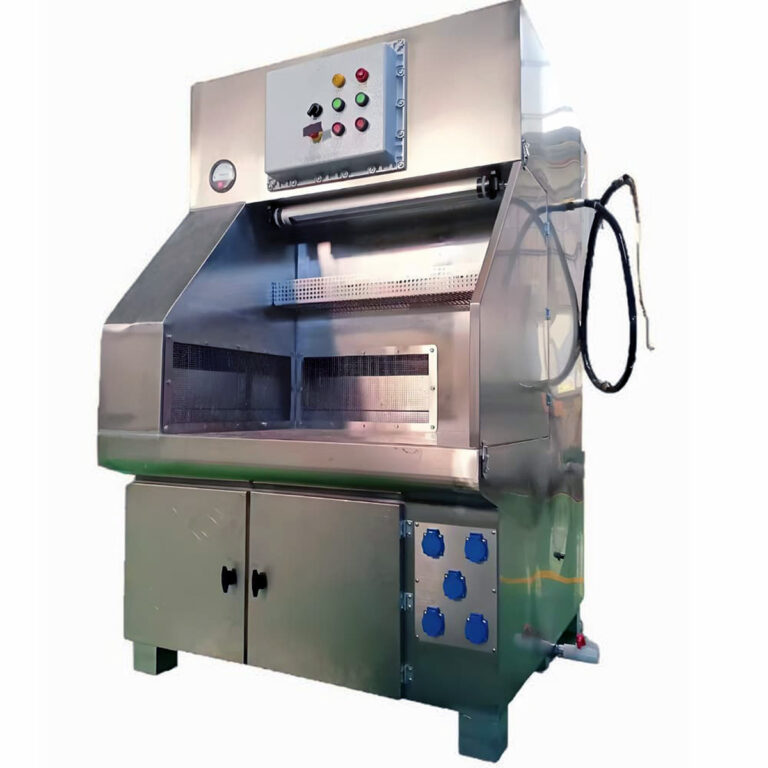
Material choice for the carcass is a strategic trade-off. MDF offers superior flatness and stability for a critical reference surface but adds considerable weight. Plywood is lighter and more structurally sound for doors and large panels but may warp over time in a shop environment. This decision balances machining precision against mobility and long-term durability. For a high-performance, integrated solution, many shops opt for a professionally engineered industrial downdraft workbench to guarantee these design parameters are met.
Key Considerations: Workpiece Coverage and Filter Maintenance
Dynamic System Resistance
Placing a large workpiece on the table blocks open area, increasing system resistance and altering airflow patterns. Your design must maintain adequate edge suction around obstructions. This is where a well-designed plenum proves its value, helping to maintain pull from the exposed perimeter even when the center is covered.
Filter Maintenance as a Performance Factor
Filter maintenance is not an afterthought but a core performance variable. A clogged filter can double the system’s static pressure, cutting effective CFM by half. Commercial units address this with features like automatic reverse-pulse cleaning, which reduces downtime and maintains consistent performance—a key factor in total cost of ownership for production environments.
Special Hazard Mitigation
For operations involving combustible dusts or certain exotic woods, standard filtration is insufficient. Wet filtration (e.g., a water bath or misting system) is often a necessary safety and compliance investment to prevent fire and explosion risks, fundamentally altering the system design and CFM requirements due to the added resistance of the water barrier.
CFM Requirements for Different Woodworking Applications
Velocity by Operation
The target capture velocity, and thus CFM, varies by operation. Sanding fine finishes generates hazardous respirable particulates requiring robust capture (200+ FPM). Heavier debris from planing or routing may be captured at lower velocities. This variability supports the “active zone” design philosophy, allowing for different suction levels in different table sections if ducted separately.
| Application | Target Air Velocity | Key Consideration |
|---|---|---|
| Fine Finish Sanding | 200+ FPM | Hazardous particulate capture |
| General Sanding | 150-200 FPM | Robust dust capture |
| Active Zone Design | Variable suction | Concentrates airflow efficiency |
Holistic Shop Integration
The downdraft table should not be planned in isolation. Its integration—whether as a standalone unit or a branch of a central system—impacts the entire shop’s dust collection strategy. Tapping it into a central system requires calculating the added CFM load and pressure drop on the main collector and may necessitate resizing ductwork. This holistic view is essential for efficient and effective shop design.
Regulatory Alignment
The requirements for controlling airborne contaminants under OSHA 29 CFR 1910.94 directly support the need for higher target velocities for operations like fine sanding. Your CFM calculation is ultimately a compliance document, proving the system’s design meets the mandated performance for worker protection.
Final Sizing Summary and Performance Verification
Consolidated Rule-of-Thumb
For a 4×8 downdraft sanding table, a practical consolidated rule-of-thumb is 150-200 CFM per square foot of perforated table surface. For a fully perforated 32 sq ft table, this leads to a target range of 4,800–6,400 CFM. After accounting for open area percentage and system losses, select a dust collector rated to deliver 5,000–8,000 CFM at your operational static pressure (typically 4-6″ H₂O).
| Rule-of-Thumb | Resulting CFM Range | Final Collector Target |
|---|---|---|
| 150-200 CFM/sq ft | 4,800 – 6,400 CFM | For 32 sq ft table |
| Accounting for Losses | 5,000 – 8,000 CFM | At operational static pressure |
| Performance Verification | Decisive downward pull | Empirical smoke/shavings test |
The Build vs. Buy Decision
For a full-scale, high-performance implementation, the complexity of achieving proper sealing, uniform airflow, and integrated safety features often makes a commercial unit more reliable and cost-effective than a DIY project. The engineering, fabrication time, and performance risk frequently outweigh the perceived upfront savings.
Empirical Validation
Finally, verify performance empirically. With the system running at full capacity, fine wood shavings or a smoke tube should be pulled decisively downward from all areas of the table, including the corners and edges with a test workpiece in place. This real-world test is the ultimate validation of your CFM calculations and mechanical design.
The decision hinges on three priorities: calculating CFM based on effective perforated area, selecting a blower using its performance curve at operational pressure, and designing for uniform airflow through proper plenum design. Neglecting any one compromises the entire system. Need professional-grade downdraft solutions engineered to these precise specifications? Explore the industrial systems designed for this exact challenge at PORVOO. For specific application questions, you can also Contact Us.
Frequently Asked Questions
Q: How do you calculate the starting CFM requirement for a 4×8 downdraft sanding table?
A: Start by multiplying the table’s surface area (32 sq ft) by your target air velocity. Industry standards recommend 150-300 FPM, so a practical mid-range target of 200 FPM yields a base requirement of 6,400 CFM. This figure represents the air volume needed across the table’s plane before accounting for design bottlenecks. For projects where initial cost estimation is critical, use this base calculation as a budgetary benchmark before adding system loss factors.
Q: Why is the perforated top design a critical bottleneck for airflow?
A: The open area percentage of the perforated top drastically increases the required velocity through the holes. For a table with only 5% open area, achieving a 200 FPM average across the surface demands hole velocities near 4,000 FPM to move the same air volume. This creates significant static pressure loss. If your design uses standard pegboard, plan for a dust collector with a much higher static pressure rating to overcome this inherent restriction.
Q: What’s the key difference between selecting a dust collector for CFM versus static pressure?
A: You must select a collector rated to deliver your target CFM at your system’s operating static pressure, not its maximum free-air rating. For a 4×8 table, industrial units are typically rated between 5,000 and 8,000 CFM at 4-6 inches of static pressure to overcome losses from the tabletop, ducting, and filters. This means you should analyze the manufacturer’s performance curve, not just the peak CFM, to ensure adequate real-world suction as filters load.
Q: How do OSHA and NFPA standards impact downdraft table design?
A: OSHA regulations like 29 CFR 1910.94 mandate that local exhaust systems effectively capture hazardous airborne contaminants, directly governing your required CFM and velocity. For fire safety, NFPA 664 sets requirements for managing combustible dust hazards, which can dictate system components, duct construction, and filter choices. This means facilities processing certain woods must integrate safety and compliance into the initial design, potentially requiring spark detection or wet filtration.
Q: What is the “active zone” design philosophy and what are its benefits?
A: Instead of perforating the entire 4×8 surface, the active zone approach only adds holes in high-traffic work areas. This concentrates the available CFM, increasing effective velocity where it’s needed and reducing wasted suction on unused table sections. The strategy can significantly lower the required blower capacity. For shops with variable operations or budget constraints, this design offers a major efficiency gain and cost reduction compared to a fully perforated top.
Q: How does workpiece placement affect system performance?
A: A large workpiece covering the table blocks open area, which increases system resistance and static pressure. This can reduce effective CFM at the table surface if the collector is undersized. Your plenum and baffling design must maintain strong edge suction around obstructions to capture dust. For operations regularly using full-sheet materials, you should oversize your collector’s CFM rating by 15-20% to compensate for this added load and maintain capture velocity.
Q: Is a DIY or commercial downdraft table more cost-effective for a professional shop?
A: While a DIY build has lower upfront cost, achieving proper sealing, uniform airflow, and integrated safety features like automatic filter cleaning is complex. Commercial units are engineered to deliver rated performance reliably and include maintenance features that reduce downtime. For a full-scale, high-performance 4×8 implementation, the total cost of ownership often makes a commercial unit more reliable and economically sound, especially when factoring in labor and performance validation.