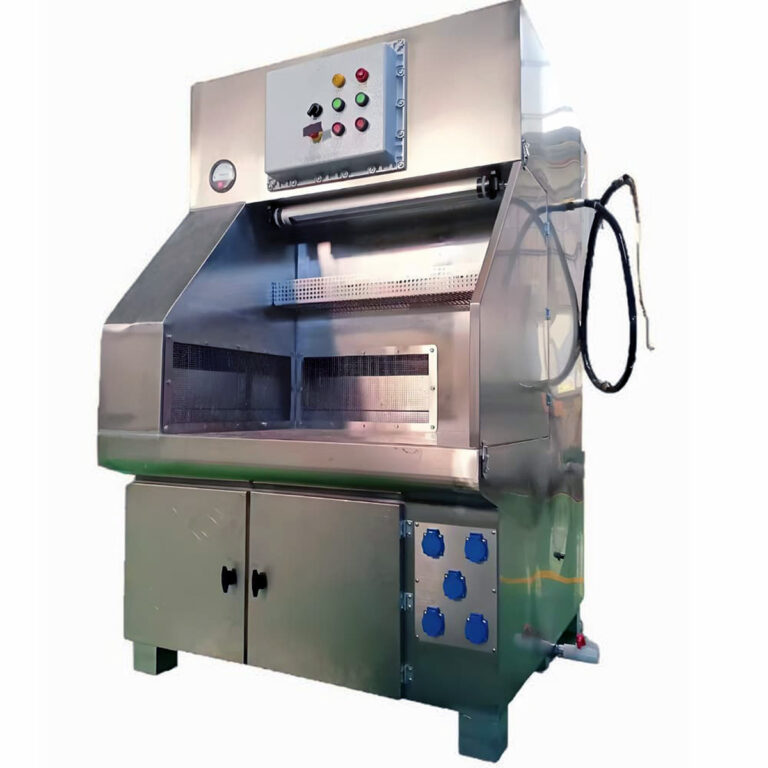
Selecting the correct downdraft sanding table is a critical engineering decision, not a simple purchase. The most common and costly mistake is undersizing the airflow, leading to ineffective dust capture, wasted capital, and persistent health and compliance risks. Professionals often rely on generic dust collector ratings or table dimensions alone, which guarantees a performance mismatch.
Accurate sizing is non-negotiable for controlling hazardous respirable dust and fumes. A system correctly matched to your specific application—whether fine wood dust or heavy metal particulate—ensures operator safety, protects equipment, and meets regulatory standards like OSHA PELs. This guide provides the calculative framework to specify a system that performs as required from day one.
How to Calculate Downdraft Table CFM: The Core Formula
The Fundamental Airflow Equation
The required airflow for any downdraft table is determined by a direct physical relationship: the open work surface area and the speed of air moving through it. The core formula is Required CFM = Table Open Area (sq ft) x Target Face Velocity (FPM). Face velocity is the critical variable; it’s the speed needed to overcome particle momentum and thermal lift, capturing contaminants at the source.
Applying the Calculation
First, convert the table’s length and width from inches to square feet (L” x W” / 144). A standard 37″ x 53″ table has an open area of approximately 13.6 sq ft. If your application requires a face velocity of 125 FPM, the calculation is 13.6 sq ft x 125 FPM = 1,700 CFM. This CFM must be delivered at the table surface, a point often overlooked when accounting for system losses downstream.
Sizing by Dimension
The required CFM scales linearly with table size. A smaller benchtop unit demands significantly less airflow than a large industrial table. Industry specifications confirm this direct correlation, making accurate area calculation the foundational step. Misjudging the effective open area by including non-perforated sections will lead to an undersized system from the start.
| Table Dimension (Inches) | Open Area (Sq Ft) | Example CFM @ 125 FPM |
|---|---|---|
| 37″ x 53″ (Standard) | 13.6 sq ft | 1,700 CFM |
| 24″ x 48″ (Benchtop) | 8.0 sq ft | 1,000 CFM |
| 48″ x 72″ (Large) | 24.0 sq ft | 3,000 CFM |
Source: Technical documentation and industry specifications.
Selecting the Right Face Velocity for Your Application
Velocity Dictates Capture Efficacy
Face velocity is not arbitrary. It is selected based on the contaminant’s characteristics and the energy of the process generating it. Fine, buoyant dust behaves differently than dense, high-velocity grinding particulate. Selecting too low a velocity fails to capture the contaminant; too high can disrupt work or waste energy.
Application-Specific Guidelines
For fine wood sanding dust, a velocity of 100-125 FPM is typically sufficient. More aggressive sanding or primer work requires 125-150 FPM to capture heavier particles. Metal deburring and light grinding need 150-175 FPM. Welding fumes and heavy grinding demand 175-200+ FPM to counteract thermal lift and particle mass. These ranges are informed by methodologies in ACGIH Industrial Ventilation: A Manual of Recommended Practice, the definitive guide for industrial ventilation design.
The Compliance Imperative
An underpowered system creates a hidden liability. It may appear to function while failing to capture the most hazardous respirable fraction. This can lead to non-compliance with exposure limits despite having control equipment in place. The chosen velocity directly inputs into your CFM calculation, making it a primary safety and compliance variable.
| Application | Target Face Velocity (FPM) | Contaminant Type |
|---|---|---|
| Fine Wood Sanding | 100 – 125 FPM | Fine, buoyant dust |
| Aggressive Wood Sanding | 125 – 150 FPM | Heavier sanding dust |
| Metal Deburring / Light Grinding | 150 – 175 FPM | Metallic particulate |
| Welding / Heavy Grinding | 175 – 200+ FPM | Heavy particulate & fumes |
Source: ACGIH Industrial Ventilation: A Manual of Recommended Practice. This manual provides the foundational methodology for determining required capture velocities based on contaminant characteristics and process forces, directly informing these application-specific ranges.
Key Factors Beyond CFM: Plenum Design & Port Configuration
Internal Aerodynamics Are Critical
A blower can move the required CFM, but if the table’s internal design creates uneven airflow or high static pressure, that CFM never reaches the work surface effectively. A flat-bottom plenum often results in dead zones with weak suction at the edges and strong pull only near the port.
Design Features for Performance
Superior tables use V-bottom or tapered plenums with internal baffles. This engineering directs airflow evenly across the entire perforated surface, ensuring consistent capture velocity. In my experience evaluating systems, this internal design is the differentiator between adequate and exceptional performance, regardless of the blower spec.
Port Sizing and Static Pressure
Port configuration is a major restriction point. A single 4″ port cannot efficiently convey 1,700 CFM without excessive static pressure loss. Larger tables require multiple 4″ ports or larger diameter ports (6″ or 8″) to minimize this loss. The duct connection must match the port size to avoid an immediate bottleneck.
Downdraft Table Sizing: Common Mistakes and Performance Pitfalls
The Undersized Collector Trap
The most prevalent error is pairing a table with an undersized dust collector. A common 1.5HP shop collector often delivers only 1200 CFM at the end of a duct run, far below the 1700+ CFM a mid-size table needs. This mismatch leads to poor capture and operator frustration, falsely blaming the table design.
Neglecting System Losses
The calculated CFM is the requirement at the table surface. Friction in ducting, elbows, and the filter itself reduces delivered airflow. Always add a 20-25% safety factor to your calculated CFM when specifying the collector. For a 1,700 CFM requirement, select a collector capable of 2,125 CFM at the required static pressure.
Operational Oversights
Performance can be crippled by simple oversights. Placing large, solid jigs or workpieces that block the perforated surface disrupts airflow patterns. Failing to clean the table surface, allowing holes to clog with debris, has the same effect. Regular maintenance is part of the system’s performance specification.
CFM Requirements for Woodworking vs. Metal & Welding
Divergent Needs, Same Calculation
While the CFM formula is constant, the input values differ drastically. Woodworking typically uses lower face velocities (100-150 FPM) for capturing fine dust. Metal and welding applications require higher velocities (175-200+ FPM) for heavier particulate, resulting in a 40-60% higher CFM requirement for the same table size.
Ancillary System Requirements
The differences extend beyond airflow. Metal grinding necessitates spark arrestance protection before the filter. Welding fume capture may require heat-resistant filter media. These are not optional accessories but essential safety features for these applications. The market is evolving toward integrated multi-process stations that accommodate these specialized needs.
Comparative CFM Scaling
A full-size cabinet for fine woodworking may require 1,360-1,700 CFM. That same cabinet used for metal grinding needs 2,380-2,720 CFM. This stark difference underscores why application, not just table size, must drive the entire system specification.
| Application | Table Size Example | Required CFM Range | Key Ancillary Need |
|---|---|---|---|
| Woodworking (Fine) | Small Benchtop | ~540 CFM | Standard filter media |
| Woodworking (Full Cabinet) | 37″ x 53″ | 1,360 – 1,700 CFM | Fine dust filtration |
| Metal Grinding | 37″ x 53″ | 2,380 – 2,720 CFM | Spark arrestance |
| Welding Fume Capture | 37″ x 53″ | 2,380 – 2,720+ CFM | Heat-resistant filters |
Source: Technical documentation and industry specifications.
Integrating Your Table: Dust Collector Selection & Ducting
The Collector Selection Imperative
The table is only the capture hood; the dust collector is the engine. Standard shop collection is often inadequate. You need a collector sized to deliver your target CFM plus the safety factor, at the system’s static pressure. Look for performance curves, not just peak CFM ratings.
Ducting for Minimum Loss
Duct design directly impacts delivered airflow. NFPA 91 Standard for Exhaust Systems for Air Conveying of Vapors, Gases, Mists, and Particulate Solids governs safe design, mandating considerations for material and layout. Use smooth-walled metal duct, minimize length, and use sweeping elbows instead of tight 90-degree turns. Each bend adds resistance, stealing airflow from the table.
Integrated vs. Remote System Strategy
This is a fundamental choice. An integrated downdraft sanding table with a built-in fan and filter offers guaranteed performance but at a higher capital cost and less flexibility. A passive table with a remote collector offers layout flexibility but requires meticulous compatibility sizing. The wrong pairing renders the system ineffective.
| System Component | Key Selection Criteria | Performance Impact |
|---|---|---|
| Dust Collector CFM | Table CFM + 20-25% safety factor | Prevents undersizing & poor capture |
| Ducting Material | Smooth-walled metal duct | Minimizes friction loss |
| Ducting Layout | Short, straight runs | Maximizes delivered airflow |
| System Type | Integrated vs. Remote | Guaranteed performance vs. flexibility |
Source: NFPA 91 Standard for Exhaust Systems for Air Conveying of Vapors, Gases, Mists, and Particulate Solids. This standard governs the safe design and installation of exhaust ductwork, mandating considerations for material, layout, and airflow to safely convey combustible dusts, directly impacting these selection criteria.
Total Cost of Ownership: Equipment, Energy, and Maintenance
Looking Beyond Purchase Price
The initial equipment cost is a single line item. A higher-CFM system consumes more energy, making operational efficiency a major long-term cost driver. Innovations like variable-speed motors that ramp down when capture needs are lower can significantly reduce lifetime energy expenditure.
The Recurring Cost of Maintenance
Filters are consumables. Fine wood dust loads filters quickly; metallic dust may require specialized media. The labor and downtime for cleaning or replacement are recurring costs. A system with easier filter access and cleaning mechanisms reduces these operational burdens.
Warranty as a Risk Mitigator
This is where professional-grade support differentiates itself. A robust 5-year warranty on the blower and structure mitigates the financial risk of downtime. For a commercial operation, this assurance of support and longevity often provides a lower total cost of ownership than a cheaper, unsupported unit.
| Cost Category | Commercial Consideration | Impact on TCO |
|---|---|---|
| Initial Equipment | Integrated vs. remote system | High capital vs. lower capital |
| Operational Energy | Higher-CFM consumption | Major long-term driver |
| Filter Maintenance | Regular cleaning/replacement | Recurring material & labor cost |
| Warranty & Support | 5-year professional warranty | Mitigates downtime risk |
Source: Technical documentation and industry specifications.
Final Selection Criteria: Choosing Your Commercial System
Verify Core Performance Specifications
First, confirm the table’s internal design (plenum, baffles, port sizing) can support the CFM and face velocity your application requires. Request performance data or third-party testing if available. Features like lowered edges for edge-sanding indicate specialized design for precision workflows.
Make the Integration Decision
Formalize your choice between an integrated system and a remote collector. The integrated path offers simplicity and performance certainty. The remote path offers flexibility but demands rigorous sizing of all components. There is no middle ground; this decision frames all subsequent equipment choices.
Evaluate the Manufacturer Partnership
For industrial use, the manufacturer is a long-term partner. Assess their technical support capability, warranty terms, and spare parts availability. Build quality that ensures uptime under daily use is a strategic financial advantage over a lower upfront cost.
Specifying a commercial downdraft system requires moving from basic calculation to holistic system integration. Prioritize achieving the correct face velocity at the work surface, then engineer the supporting collection and ducting to deliver it reliably. Factor in the total cost of ownership, where energy efficiency and strong support mitigate long-term operational risk.
Need a professionally engineered solution sized for your specific woodworking or metal fabrication application? The experts at PORVOO can help you specify a system based on your table dimensions, contaminants, and workflow. Review technical specifications for a heavy-duty downdraft workbench designed for industrial airflow as a reference for commercial-grade design.
For a detailed consultation on your requirements, Contact Us.
Frequently Asked Questions
Q: How do you calculate the required CFM for a downdraft sanding table?
A: You determine the required airflow by multiplying the table’s open surface area in square feet by the target face velocity in feet per minute. First, convert the table’s length and width from inches to square feet. For example, a 37″ x 53″ table has an open area of about 13.6 sq ft. This means your initial system specification must start with this precise calculation to ensure the collector can meet the fundamental airflow demand.
Q: What face velocity should I target for welding fume capture versus wood sanding?
A: Welding and heavy grinding require a high face velocity of 175-200+ FPM to overcome thermal lift and particle mass, while fine wood sanding typically needs only 100-125 FPM. Selecting the correct velocity is critical because an underpowered system fails to capture hazardous respirable dust, creating a compliance risk. For projects where you handle mixed materials, plan for a system capable of the highest required velocity, which dictates a significantly higher CFM for the same table size.
Q: Why does a downdraft table’s internal plenum design matter as much as the CFM rating?
A: A table’s internal aerodynamics, like V-bottom plenums and baffles, ensure even suction across the entire work surface, preventing dead zones. Port configuration also limits airflow; multiple 4″ ports are needed on larger tables to minimize static pressure loss from a single restrictive port. This means facilities prioritizing consistent particle capture should evaluate internal design as a primary selection criterion, as a well-engineered smaller table can outperform a poorly designed larger one.
Q: What is the most common mistake when sizing a complete downdraft collection system?
A: The prevalent error is undersizing the remote dust collector for the table’s CFM requirement, often by using an underpowered shop collector. You must also account for system losses by adding a 20-25% safety factor to your calculated table CFM when selecting the collector. For operations where duct runs are long or convoluted, expect to need an even more powerful collector to compensate for friction losses and maintain effective capture at the source.
Q: How do industry standards like NFPA 91 influence downdraft table system design?
A: Standards like NFPA 91 set minimum requirements for exhaust systems conveying combustible particulates, governing the safe design and installation of ductwork. This directly impacts system design by mandating certain construction materials and airflow velocities to prevent hazardous dust accumulation. Facilities processing wood or composite dust must therefore ensure their entire system, from table to collector, complies with such standards to mitigate fire and explosion risks.
Q: Should I choose an integrated downdraft table or a passive table with a remote collector?
A: This is a fundamental trade-off between guaranteed performance and flexibility. Integrated systems offer optimized, guaranteed capture at a higher capital cost. Passive tables with remote collectors offer layout flexibility but require you to meticulously size the collector and ducting for compatibility. If your operation values predictable performance and has a fixed location, the integrated path reduces engineering risk, despite the higher initial investment.
Q: What are the key total cost of ownership factors beyond the purchase price?
A: Operational energy consumption for the blower motor and ongoing filter maintenance are the primary long-term costs. Systems with variable-speed drives can reduce energy use, while filter type and access impact maintenance labor and downtime. This means commercial shops should evaluate warranty terms and technical support, as robust support can offer a better lifetime value by minimizing costly production interruptions compared to a cheaper, unsupported unit.