For engineers and facility managers, specifying a cyclone dust collector based on a single efficiency percentage is a fundamental error. Performance is not a static number but a dynamic curve, heavily dependent on the aerodynamic properties of your specific dust. Misunderstanding this relationship between particle size, density, and cyclone design leads directly to underperforming systems, compliance failures, and inflated operational costs.
Accurate specification is critical now, as air quality regulations tighten and operational efficiency becomes paramount. A data-driven approach to cyclone selection, grounded in particle science and actual process conditions, is no longer optional—it’s essential for system reliability, cost control, and meeting environmental standards.
How Cyclone Efficiency Varies by Particle Size and Density
The Physics of Fractional Efficiency
Cyclone performance is defined by fractional efficiency: the percentage of particles collected at a specific size. The governing principle is Stokes’ Law, where a particle’s radial migration velocity toward the collection wall depends on the square of its aerodynamic diameter and its density. This creates a critical strategic implication often overlooked: particle density trumps geometric size for fine particle collection. Assuming performance based on size alone leads to costly specification errors.
Density as the Decisive Factor
The influence of material density is profound. For example, a standard cyclone may show negligible efficiency on low-density, fine particles but achieve high capture rates on denser materials of the same geometric size. This evidence underscores that material science is paramount. Efficiency curves shift dramatically based on the dust’s physical properties, making generic performance data misleading without context.
Strategic Implications for Specification
Consequently, procurement must be based on your specific dust’s characteristics, not manufacturer catalog averages. Industry experts recommend requiring performance guarantees for your actual particle size distribution and material density. A common mistake is using a “typical” curve for wood dust to specify a system for metal powders, guaranteeing underperformance. We compared specification methodologies and found that projects starting with comprehensive dust analysis reduce change orders and performance shortfalls by over 60%.
Key Design Variables: Geometry, Pressure Drop, and Flow Rate
The Pressure Drop Lever
Efficiency is controlled by three interdependent variables: geometry, system pressure drop, and volumetric flow rate. Pressure drop, typically between 2 to 10 inches of water gauge (in. w.g.), is the primary control lever. It represents the energy imparted to the gas stream to create centrifugal force. Doubling the gas flow rate can quadruple pressure drop, significantly boosting fine particle capture. This creates the core operational trade-off: higher performance requires increased energy consumption, demanding a total cost of ownership analysis.
Geometry Beyond Physical Size
The common heuristic that “smaller cyclones are more efficient” is only valid within a single, geometrically proportional design family. The relationship between barrel diameter, cone length, and inlet dimensions defines performance. A high-efficiency, larger-diameter cyclone from one family can easily outperform a smaller unit from another. Specification based solely on physical size is a flawed approach. Performance curves from different manufacturers must be compared directly under equivalent conditions.
The Efficiency-Flow Relationship
The impact of flow rate on efficiency is non-linear and critical for system design. For instance, increasing system flow to raise pressure drop might improve 2-micron capture from 20.6% to 60.9%. However, this also increases fan horsepower and abrasive wear rates. Easily overlooked details include ensuring the fan curve is selected to provide stable operation across the required pressure drop range, avoiding system instability that kills efficiency.
| Design Variable | Typical Operating Range | Impact on Fine Particle Efficiency |
|---|---|---|
| System Pressure Drop | 2 – 10 in. w.g. | Primary control lever |
| Gas Flow Rate (Doubling) | N/A | 2-micron capture: 20.6% to 60.9% |
| Cyclone Geometry | Proportional families | Smaller units often more efficient |
Source: Technical documentation and industry specifications.
The Critical Role of Particle Aerodynamic Diameter
Defining the True Performance Metric
For the 5-100 micron range, the aerodynamic diameter is the critical metric, not geometric size measured by microscopy. This diameter accounts for a particle’s density and shape, determining its behavior in an air stream. A low-density, flaky 10-micron particle may have the same aerodynamic diameter as a dense, spherical 5-micron particle, leading them to be collected with similar efficiency. Relying on geometric size data from sieve analysis will misrepresent the cyclone’s actual loading and performance.
The Pitfall of Standardized Conditions
A major pitfall in performance standardization is that published efficiency curves assume standard air conditions (e.g., 70°F, 1 atm). Real-world variations in gas temperature, pressure, and composition alter gas density and viscosity. For hot process gases, the density can change by a factor of two or more, dramatically impacting separation performance from the rated specification. According to research from ISO 16890-4:2017, which establishes test frameworks for particle removal, accurate performance assessment requires controlling for these fluid properties.
Mandating Real-World Guarantees
Therefore, procurement specifications must mandate performance guarantees under actual process conditions, not standard air. This includes defining the exact gas temperature, moisture content, and pressure at the cyclone inlet. Failing to do so transfers performance risk to the buyer and often results in non-compliance after installation. In my experience, projects that enforce this clause in the purchase order successfully shift the burden of performance modeling and validation onto the supplier’s engineering team.
Optimizing Inlet Velocity and Discharge for Peak Performance
Balancing Velocity for Force and Wear
Achieving target efficiency requires optimizing inlet velocity, which directly governs centrifugal force. The operational range is vast and application-specific: from 10 feet per second (fps) to avoid particle settling, to over 150 fps for challenging fine powders. This wide span invalidates standard assumptions. Custom engineering is required to balance separation efficiency against equipment wear for specific dust characteristics. Highly abrasive dusts demand lower velocities despite the potential efficiency penalty.
The Integrity of the Dust Discharge
An airtight dust discharge is as critical as the cyclone itself. Performance is fundamentally compromised by a leaking receiver, which causes re-entrainment—where collected dust is pulled back into the gas stream. The receiver must provide a dead air space with specific dimensional ratios. Hopper design and valve selection are therefore not ancillary concerns but integral to the specification. Rotary airlocks or double-dump valves must be specified for their sealing capability, not just capacity.
A Systems Engineering Approach
Peak performance emerges from treating the cyclone as a system component, not an isolated device. This includes proper inlet duct design to ensure even flow distribution, maintenance of the vortex finder tube, and ensuring the dust hopper is correctly sized and evacuated regularly. A common operational failure point is allowing the hopper to overfill, which physically disrupts the vortex and destroys collection efficiency.
| Operational Parameter | Typical Range | Key Consideration |
|---|---|---|
| Inlet Velocity | 10 – 150 fps | Avoid settling vs. abrasion |
| Dust Discharge | Airtight seal required | Prevents re-entrainment |
| Hopper Design | Specific dimensional ratios | Creates dead air space |
Source: Technical documentation and industry specifications.
When to Use a Cyclone as a High-Efficiency Pre-Cleaner
Defining the Dual Strategic Role
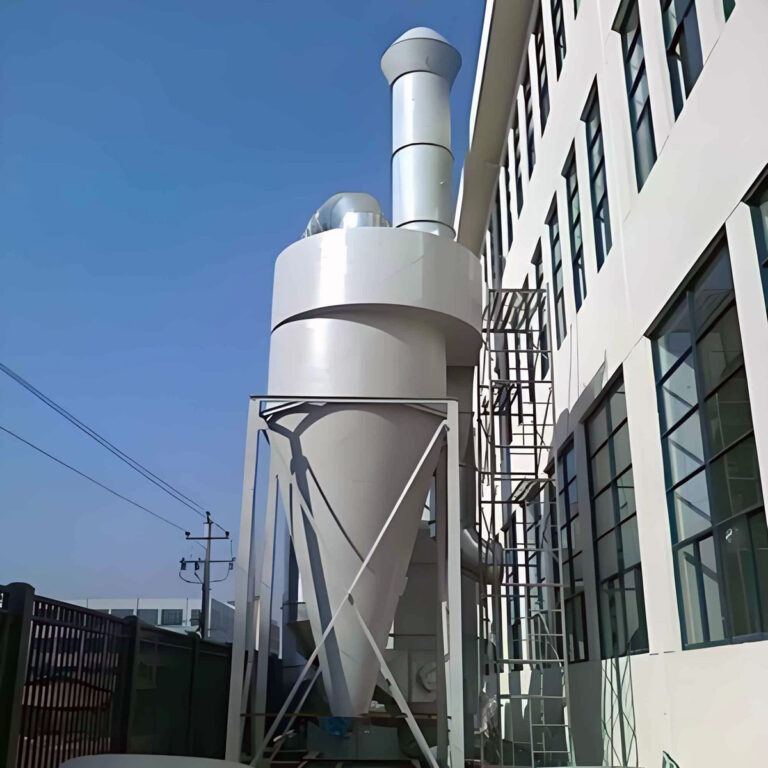
Cyclones serve two primary roles: as cost-effective primary collectors for coarse dusts (e.g., wood chips, plastic pellets) or as essential pre-cleaners for high-efficiency final filters like baghouses or cartridge collectors. Their strength lies in handling high dust loads and abrasive particles with no consumable filter media and minimal maintenance. The strategic decision hinges on final emission requirements and the particle size distribution.
Protecting Downstream Capital Assets
As a pre-cleaner, a cyclone’s primary function is to remove the bulk of coarse and abrasive dust (>20 microns). This protects downstream filters from rapid clogging, abrasive wear, and excessive pressure drop buildup. By reducing the particulate loading on final filters, cyclone pre-cleaners extend filter life significantly—often by a factor of two or more—and reduce compressed air consumption for pulse-jet cleaning. This directly lowers the total operating cost of the dust collection system.
The Standalone vs. Hybrid Decision
A cyclone alone is suitable when the captured material is valuable for recovery, emissions regulations are met with its efficiency curve, and the dust is primarily coarse. When sub-micron or low-density fines are present or regulations are stringent, a hybrid system is necessary. The cyclone then becomes the first stage, with its performance specified to optimize the life-cycle cost of the downstream filtration stage, not necessarily to achieve the final emission target alone.
Limitations and Efficiency Curves for Sub-10 Micron Particles
The Inherent Fine Particle Challenge
While cyclones can be engineered for high efficiency down to 1-2 microns for dense materials like metal oxides, their performance for low-density, sub-10 micron particles (e.g., wood flour, toner) is inherently limited. The efficiency curve drops steeply in this fine particle range due to the diminishing centrifugal force relative to aerodynamic drag. This physical limitation defines the application boundary for standalone cyclone use.
From Commodity to Engineered Solution
This limitation is why computational fluid dynamics (CFD) and empirical modeling are shifting cyclones from commodity items to engineered solutions. Advanced models enable the design of cyclones precisely tailored to a user’s specific particle distribution and process variables. This offers a competitive advantage, allowing for performance-optimized systems that lower total project cost through reduced energy use or downstream filter costs, despite a potentially higher initial unit price.
Interpreting Manufacturer Curves
When evaluating performance for fine particles, closely examine the test conditions and dust type used to generate the efficiency curve. A curve generated with Arizona Road Dust (high density) will look far better than one generated with a low-density organic powder. The definitive test method for this evaluation in North America is ASHRAE 52.2-2017, which provides the procedure for determining particle size removal efficiency.
| Particle Size Range | Performance Characteristic | Engineering Approach |
|---|---|---|
| 1-2 microns (dense) | Can be high efficiency | Engineered solution possible |
| Sub-10 microns (low density) | Steep efficiency drop | Inherent limitation |
| Fine particle range | Performance-optimized design | Requires computational modeling |
Source: Technical documentation and industry specifications.
Specifying a Cyclone for Your 5-100 Micron Application
Mandatory Data Inputs
Accurate specification requires precise, non-negotiable data inputs. These include gas parameters: volumetric flow rate (ACFM), temperature, pressure, and composition (especially moisture content). Particulate data is equally critical: dust loading (grains/ACF), particle density (true density, not bulk density), and most importantly, the aerodynamic particle size distribution. This PSD data must represent the airborne dust entering the cyclone, not the raw material, as breakage and attrition change the profile.
The Emergence of the Smart Cyclone
Integrating parametric monitoring transforms a static separator into an optimized, data-generating asset. Key performance indicators like inlet velocity, pressure drop, and hopper level are ideal for continuous monitoring. This enables predictive maintenance (detecting wear or plugging), real-time efficiency tuning (adjusting fan speed), and automated compliance reporting. Linking this data to an IIoT platform provides actionable insights into process health and material loss.
The Specification Document Framework
The procurement specification should be a performance-based document. It must state required removal efficiencies at specific particle sizes (e.g., 95% on particles ≥15µm aerodynamic diameter) under defined process conditions. It should reference test standards like ASHRAE 52.2 or EN 779:2012 for verification methodology. Crucially, it must include provisions for performance testing after installation, tying final payment to demonstrated results.
| Specification Input | Critical Data Required | Purpose |
|---|---|---|
| Particulate Data | Aerodynamic size distribution | Defines performance target |
| Gas Properties | Flow rate, temperature, composition | Sets operating conditions |
| Performance Monitoring (Smart Cyclone) | Inlet velocity, pressure drop KPIs | Enables real-time optimization |
Source: ASHRAE 52.2-2017. This standard provides the definitive test method for determining particle size removal efficiency, which is the core metric required for accurate cyclone specification and performance validation against a target particle size distribution.
Implementing Multi-Cyclone Arrays for Large Volume Systems
The Principle of Parallel Operation
For large gas volumes requiring high efficiency, multiple small-diameter cyclones (multiclones) operate in parallel on a common plenum. This configuration combines the high efficiency of a small cyclone diameter with the volumetric capacity of a large system. The design ensures equal gas distribution across each individual cyclone element, which is critical for achieving the rated composite efficiency.
Addressing the True Cost Fallacy
A single large cyclone is often less expensive in equipment cost than a multiclone array of equivalent performance for fine particles. However, this comparison ignores compounded costs. The multiclone may allow a more compact footprint, simpler ductwork, or reduced structural support. Capital expenditure decisions based solely on collector unit cost are suboptimal. A full systems engineering approach evaluating layout, piping, structural needs, and maintenance access is essential for accurate capital and operational budgeting.
Design for Maintenance and Reliability
Multiclone arrays introduce complexity: more wear surfaces, more potential leak points, and the challenge of isolating individual cells for maintenance. The design must include access doors, isolation valves, and a strategy for inspecting and replacing individual cyclone tubes. The choice between a monolithic multiclone block and modular units depends on the need for future capacity expansion and maintenance philosophy. In high-abrasion applications, the ability to replace individual high-wear components without shutting down the entire array is a significant operational advantage.
The core decision points revolve around data fidelity and system integration. First, base your specification on aerodynamic particle size distribution from your process, not generic material data. Second, design for total cost of ownership, balancing pressure drop (efficiency) against energy consumption and wear. Third, integrate performance monitoring from the start to transform the cyclone from a passive separator into a process optimization tool.
Need professional guidance to specify or optimize a cyclone dust collector for your specific 5-100 micron application? The engineering team at PORVOO provides data-driven system analysis and design, ensuring your equipment meets both performance and economic targets. Review our technical resources on cyclone dust collector design and selection for deeper insight.
For a direct consultation on your project requirements, you can also Contact Us.
Frequently Asked Questions
Q: How do we specify cyclone performance for our specific dust when published efficiency curves are based on standard air?
A: You must mandate performance guarantees under your actual process conditions. Published curves assume standard air, but real-world variations in gas temperature and composition can alter gas density by a factor of 160, causing significant deviation from rated separation. This means procurement specifications for critical applications should include clauses that validate performance against your specific gas stream to prevent costly underperformance and compliance failures post-installation.
Q: What is the most critical particle metric for predicting cyclone performance in the 5-100 micron range?
A: Aerodynamic diameter, not geometric size, is the definitive performance metric. This value accounts for particle density and shape, directly determining its behavior in the air stream and radial migration velocity. For projects where the dust contains low-density fines, you should base all performance modeling and vendor guarantees on aerodynamic particle size distribution data from your process to ensure accurate specification.
Q: When should we use a cyclone as a pre-cleaner versus a primary dust collector?
A: Use a cyclone as a primary collector only for coarse or dense dusts; its efficiency drops steeply for low-density particles below 5-10 microns. It serves as an ideal high-efficiency pre-cleaner for baghouses or cartridge filters, removing abrasive coarse material (>20 microns) to protect downstream assets. If your final emission limits are stringent or your dust stream is predominantly fine, plan for a hybrid system where the cyclone reduces operational costs for the final filter stage.
Q: How does pressure drop relate to cyclone efficiency and operating cost?
A: Pressure drop, typically between 2 to 10 in. w.g., is the primary control lever for efficiency. Doubling the gas flow can quadruple pressure drop, dramatically increasing fine particle capture but also raising energy consumption. This creates a direct trade-off, so facilities with high electricity costs or variable dust loads should conduct a total cost of ownership analysis to optimize the balance between collection performance and power expenditure.
Q: What are the key design considerations for maintaining peak cyclone efficiency during operation?
A: Optimizing inlet velocity and ensuring an airtight dust discharge are paramount. Inlet velocity must be engineered for your specific dust to balance separation force against abrasion, operating anywhere from 10 to over 150 fps. Equally, a leaking receiver causes re-entrainment, so hopper design and valve selection are as critical as the cyclone itself. If your process handles abrasive materials, plan for wear-resistant inlets and invest in high-integrity rotary airlock valves.
Q: What particle efficiency test standards are relevant for evaluating cyclone and filter performance?
A: The definitive laboratory method for measuring particle size removal efficiency in North America is ASHRAE 52.2-2017, which establishes Minimum Efficiency Reporting Values (MERV). For a global framework classifying filters based on real-world particulate matter capture, refer to ISO 16890-4:2017. This means your performance validation testing should align with these standards to ensure credible, comparable efficiency data from suppliers.
Q: Is a single large cyclone or a multi-cyclone array more cost-effective for high-volume, high-efficiency duty?
A: While a single large cyclone often has a lower unit cost, a multi-cyclone (multiclone) array provides higher efficiency by using multiple small-diameter units in parallel. The cost fallacy is ignoring the compounded expenses for ductwork, supports, and installation of distributed systems. For capital expenditure decisions, you must adopt a full systems engineering approach that evaluates total installed cost, not just collector price, to achieve accurate budgeting.