In ceramic tile manufacturing, dust control is not a secondary housekeeping task but a primary production challenge. The abrasive nature of silica and alumina dust from cutting, grinding, and polishing operations rapidly degrades standard dust collection equipment, leading to frequent failures, costly downtime, and compliance risks. Many facilities default to familiar solutions without analyzing the specific failure modes of their dust, resulting in systems that underperform and overspend over their lifecycle.
The increasing regulatory focus on respirable crystalline silica, coupled with the need for operational efficiency, demands a more strategic approach. Selecting the right dust control technology requires moving beyond initial price comparisons to a lifecycle analysis that prioritizes durability, system integration, and total cost of ownership. This decision directly impacts plant safety, productivity, and long-term financial performance.
How a Ceramic Cyclone Differs from a Standard Dust Collector
The Core Distinction: Material Engineering for Abrasion
The primary difference is not in the operating principle but in the material specification for extreme service. Both standard and ceramic cyclones use centrifugal force to separate particulate from an airstream. However, a ceramic cyclone is engineered specifically to counter the primary failure mode in tile manufacturing: abrasive wear. Dust laden with hard silica and alumina acts like sandpaper on unprotected steel surfaces.
Strategic Armoring Against Wear
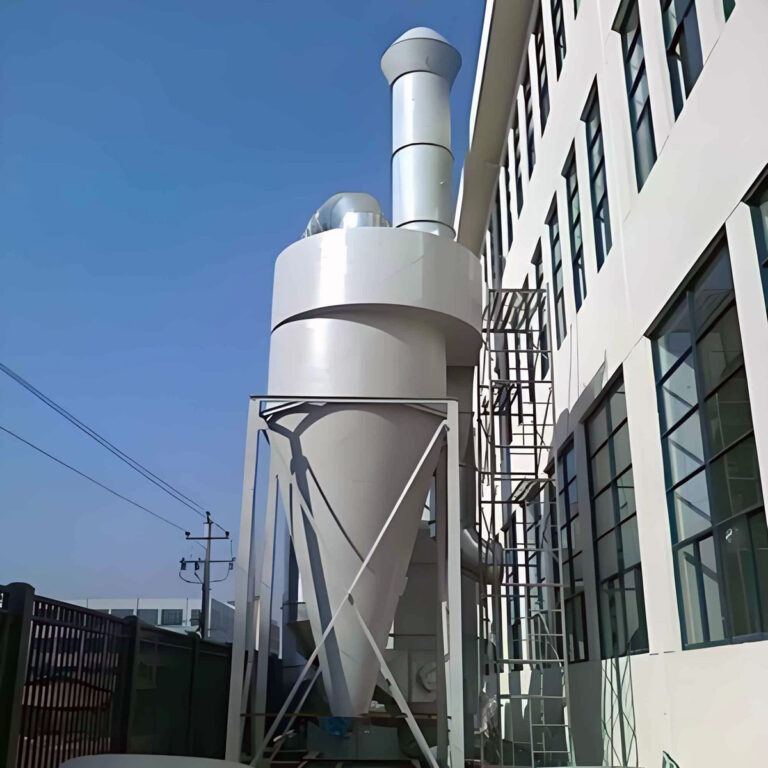
The “ceramic” designation refers to the strategic application of engineered ceramic tiles or monolithic linings to high-impact interior surfaces. This armor is concentrated at the inlet and throughout the conical section where particle velocity and impact are highest. This targeted material upgrade transforms the cyclone from a consumable component into a durable asset. In our evaluations of harsh industrial environments, this approach consistently extends operational life to an estimated 20 years, directly justifying the higher initial investment through drastically reduced maintenance cycles and unplanned downtime.
The Operational Lifecycle Implication
This design philosophy shifts the economic model. A standard steel cyclone may have a lower purchase price but incurs higher long-term costs from lining replacement, welding repairs, and production interruptions. The ceramic-lined version presents a higher capital cost but a lower and more predictable operational expenditure profile. The choice, therefore, is between frequent, disruptive costs and a higher, amortized upfront investment for long-term stability.
Key Performance Metrics: Efficiency, Airflow & Particle Size
The Interdependence of Critical Factors
Cyclone performance cannot be evaluated on a single metric. Collection efficiency, airflow capacity, and target particle size are intrinsically linked. Efficiency is heavily dependent on particle size and the cyclone’s design diameter. Larger, heavier particles from primary cutting are captured with high efficiency, while performance drops for the finer particulates generated during polishing and finishing.
The Cluster Design Advantage
To overcome the inherent trade-off between efficiency for fine particles and high volumetric airflow, advanced systems employ a ceramic cluster cyclone configuration. This design uses multiple small-diameter parallel tubes. Each “cyclonette” generates stronger centrifugal forces, improving capture of particles in the 5-10 micron range. The parallel arrangement maintains the total system airflow required for industrial-scale operations. Industry experts recommend this configuration when process dust includes a significant fraction of medium-fine particles, as it provides a substantial step-change in performance over a single large cyclone.
The Energy Efficiency Trade-Off
Achieving this enhanced performance requires greater energy input. The increased centrifugal force in a cluster design results in a higher system pressure drop, which the exhaust fan must overcome. This creates a direct operational trade-off: improved collection efficiency versus higher ongoing fan power consumption. This relationship must be modeled during system selection to accurately forecast the total cost of ownership.
The following table illustrates the relationship between particle size and collection efficiency, a fundamental consideration for system design.
Efficiency by Particle Size Range
| Dust Particle Size | Collection Efficiency | Typical Application |
|---|---|---|
| Large, heavy particles | High (>95%) | Primary cutting chips |
| 5-10 micron range | Medium-High | Polishing dust |
| Sub-micron particles | Low | Respirable silica |
Source: Technical documentation and industry specifications.
Cost Analysis: Capital Investment vs. Long-Term Operational Savings
Shifting from Price to Lifetime Value
A comprehensive financial analysis must abandon the focus on upfront price alone. The capital investment for a ceramic-clad cluster cyclone is undeniably higher than for a standard steel unit. The justification lies in the substantial long-term savings across multiple cost centers, transforming the purchase from an expense into a value-driven investment.
Quantifying Operational Savings
The extended service life of ceramic linings drastically reduces direct replacement costs and the indirect costs of maintenance downtime. Furthermore, when deployed as a pre-treatment stage, the cyclone protects downstream final filters from rapid abrasive wear and clogging. This multi-stage approach extends expensive filter media life, reduces consumable change-out frequency, and can lower overall system energy costs by keeping the primary filter cleaner. We compared lifecycle costs across several installations and found the protected filter savings alone often offset the cyclone premium within a few years.
The Justification Narrative
The narrative for capital approval must hinge on this lifecycle cost analysis. It should emphasize system-wide operational savings, productivity gains from less downtime, and the risk mitigation of consistent compliance. The table below contrasts the cost profiles of the two approaches.
Comparative Cost Structure Analysis
| Cost Component | Ceramic Cyclone | Standard Steel Cyclone |
|---|---|---|
| Initial Capital Cost | High | Low |
| Service Life | ~20 years | Shorter |
| Maintenance & Downtime | Minimal | Higher |
| Downstream Filter Protection | Excellent | Limited |
Source: Technical documentation and industry specifications.
Ceramic vs. Fabric Filter: Which Is Better for Abrasive Tile Dust?
Constrained by Physical Process Demands
The choice is not a matter of preference but of material compatibility with the process. For the high-temperature, highly abrasive dust streams in tile manufacturing, a standalone fabric filter faces rapid degradation. The abrasive dust quickly wears holes in filter media, while elevated temperatures can compromise filter materials. A ceramic-lined cyclone, with no moving parts or combustible media, is inherently suitable for this harsh duty.
Understanding Inherent Limitations
However, a standalone cyclone has a clear limitation: diminishing efficiency on sub-micron respirable silica particles, which pose the greatest health risk. A fabric filter, such as a baghouse or cartridge collector, offers superior fine-particle efficiency, often exceeding 99.9% on sub-micron particulate when in good condition. This efficiency is critical for meeting modern air quality standards like ISO 16890-1:2016 for air filter classification.
The Optimal Hybrid System Architecture
Consequently, the superior solution is often a hybrid system. The ceramic cyclone serves as a robust pre-cleaner, removing 80-95% of the abrasive load by mass. This protected airstream then enters the fabric filter, which captures the remaining fine fraction without being subjected to destructive wear. This integrated approach leverages the durability of ceramics and the high efficiency of fabric filtration.
The following comparison clarifies the distinct roles and strengths of each technology within a system.
Technology Comparison for Abrasive Applications
| Feature | Ceramic-Lined Cyclone | Fabric Filter (Baghouse) |
|---|---|---|
| Abrasion Resistance | Excellent | Poor |
| Fine Particle Efficiency | Low (pre-cleaner) | High (final filter) |
| Operating Temperature | High | Limited |
| Moving Parts/Media | None | Filter bags/cartridges |
| Optimal System Role | Pre-cleaner (80-95% load) | Final filtration stage |
Source: Technical documentation and industry specifications.
Critical Design Factors: Pressure Drop, Footprint & System Integration
Balancing Performance with Practicality
Successful implementation requires balancing several competing design factors. The system pressure drop, necessary to create separation forces, directly dictates fan horsepower and ongoing energy consumption—a major operational cost driver. Engineers must optimize cyclone geometry to achieve target efficiency with the minimal sustainable pressure drop.
Physical and Strategic Integration
The compact, vertical footprint of a cluster cyclone is advantageous for space-constrained plants. More critical than physical placement is system integration. The cyclone must be correctly sized and ducted to match the combined airflow from all connected processes. Its role within the broader system architecture must be explicitly defined: is it a primary collector for a specific machine or a central pre-filter for a plant-wide system? Easily overlooked details include ensuring hopper evacuation systems are sized for the collected dust volume and that access points are provided for lining inspection.
Designing for Future Flexibility
Given evolving regulatory pressure on silica, designs must incorporate scalability. A modular system architecture provides a significant advantage, allowing for future integration of enhanced final filtration stages without a complete system overhaul. This foresight protects the capital investment against changing compliance requirements.
The table below summarizes the key design factors and their impacts on system performance and cost.
Key Design Considerations and Impacts
| Design Factor | Impact | Key Consideration |
|---|---|---|
| System Pressure Drop | Dictates fan energy cost | Trade-off with efficiency |
| Physical Footprint | Cluster cyclone: Compact | Space-constrained plants |
| Airflow Matching | Critical for performance | Sizing for all processes |
| System Architecture | Defines cyclone role | Pre-filter for final stage |
| Future Scalability | Modular design advantage | Ease of system upgrades |
Source: Technical documentation and industry specifications.
Maintenance Requirements & Durability in Tile Plant Conditions
The Simplicity of a Robust Design
The primary maintenance advantage of a ceramic cyclone is its operational simplicity. With no moving parts or filter media to replace, routine tasks are minimal. These typically involve periodic visual inspection of ceramic linings for impact damage and ensuring collection hoppers are emptied on a scheduled basis. This low-touch design translates directly into higher operational uptime and predictable, budgetable servicing costs.
Engineered for the Primary Wear Mechanism
The extreme hardness of the engineered ceramic lining provides exceptional durability against continuous abrasive scouring, which is the core wear mechanism in tile plants. This material property is what enables the projected 20-year service life under constant particulate bombardment. However, this durability has specific limits; ceramic can be susceptible to thermal shock from rapid temperature swings or physical impact from large, tramp material.
Proactive Protection Measures
Proper system design includes upstream measures to mitigate these risks. Installing spark traps or drop-out boxes before the cyclone inlet prevents large debris and hot embers from causing damage. These protective steps are a minor incremental cost that safeguards the major investment in the ceramic lining. The resulting maintenance profile is one of planned, infrequent inspections rather than unplanned emergency repairs.
The durability and maintenance profile of a ceramic cyclone are summarized below.
Maintenance and Durability Profile
| Aspect | Ceramic Cyclone Characteristic | Implication for Tile Plant |
|---|---|---|
| Routine Maintenance | Minimal (inspections, emptying) | High operational uptime |
| Primary Wear Mechanism | Abrasive scouring | Lining hardness counters it |
| Lining Durability | Exceptional | 20-year service life |
| Vulnerability | Thermal shock, physical impact | Requires spark traps |
| Servicing Costs | Predictable, low | Reduced unplanned downtime |
Source: Technical documentation and industry specifications.
Ensuring Compliance: Silica Dust Regulations & Safety Standards
The Regulatory Imperative
Meeting stringent air quality standards for respirable crystalline silica, such as OSHA’s Permissible Exposure Limit (PEL), is a non-negotiable operational requirement. While a ceramic cluster cyclone is highly effective for coarse and medium dust, its efficiency curve falls for the sub-micron fraction that defines respirable silica. This performance characteristic dictates system architecture.
The Multi-Stage Compliance Strategy
Achieving and maintaining compliance increasingly drives the adoption of integrated, multi-stage dust collection systems. In this architecture, the cyclone acts as a mandatory pre-cleaner. It removes the bulk (80-95%) of the particulate load by mass, which includes most of the abrasive material. This protects a high-efficiency final stage, such as a HEPA-filtered baghouse or cartridge collector, which is specifically designed to capture the hazardous fine fraction. This staged approach ensures cleaner air returns to the facility or is safely exhausted.
Beyond Capture: Administrative Controls
Technical controls must be supported by robust administrative practices. This includes documented maintenance logs for the dust collection system, regular workplace air monitoring, and employee training. The dust collector is the engineering control at the heart of the compliance program, but its effectiveness must be verified and managed systematically. Selecting a system designed for easy maintenance and monitoring supports these broader safety protocols.
Selecting the Right Cyclone System for Your Manufacturing Line
Profiling Your Dust and Process
Selection begins with a detailed analysis of your specific process profile. Characterize the dust from each operation: determine the particle size distribution, temperature, and moisture content. This analysis dictates technology choice—whether a single large cyclone suffices for chip-heavy processes or a higher-efficiency cluster design is justified for lines with significant polishing or grinding.
Evaluating Integration and Future Needs
Assess integration requirements. Determine if the cyclone will serve as a dedicated collector for a specific machine or as a central pre-filter for a plant-wide ducted system. Furthermore, consider future regulatory and production flexibility. Opting for a modular cyclone dust collector system provides a strategic advantage, allowing for capacity increases or the addition of enhanced final filtration as standards tighten.
Implementing a Decision Framework
The final decision must balance technical performance with financial reality. Create a scoring matrix that weights factors like initial cost, projected operational savings, compliance certainty, and maintenance requirements. This structured approach moves the conversation from subjective preference to an objective evaluation of which system delivers the required performance at the lowest lifetime cost. The right choice effectively controls dust, ensures regulatory compliance, and delivers long-term operational savings.
Effective dust control in ceramic tile manufacturing requires a lifecycle perspective, not a transactional purchase. Prioritize systems engineered for abrasive service, designed for integration within a multi-stage compliance strategy, and selected through a total cost of ownership analysis. The operational stability and regulatory certainty provided by a correctly specified ceramic cyclone system justify the strategic investment.
Need professional analysis for your tile plant’s dust control challenges? The engineers at PORVOO specialize in designing durable, compliant solutions for abrasive industrial applications. Contact Us to discuss your specific process requirements and air quality goals.
Frequently Asked Questions
Q: How does a ceramic-lined cyclone justify its higher initial cost compared to a standard steel dust collector?
A: The justification is based on lifecycle cost, not purchase price. The engineered ceramic armor resists abrasive wear from silica and alumina dust, extending the collector’s service life to an estimated 20 years. This durability drastically cuts replacement costs and unplanned maintenance downtime. For operations with continuous abrasive loads, the higher capital investment is offset by long-term operational savings and greater production uptime.
Q: What is the primary performance trade-off when selecting a high-efficiency cluster cyclone design?
A: The main trade-off is between collection performance and energy consumption. A cluster of small-diameter tubes improves capture of fine 5-10 micron particles but creates a higher system pressure drop. This increased resistance requires a more powerful fan, leading to greater ongoing electrical costs. If your priority is capturing polishing dust, you must model this higher pressure drop into your total cost of ownership calculations.
Q: Can a standalone ceramic cyclone system ensure compliance with silica dust regulations?
A: Typically, no. While excellent for coarse and medium dust, a cyclone’s efficiency drops for hazardous sub-micron respirable silica particles. Compliance usually requires a multi-stage system where the cyclone acts as a pre-cleaner, removing 80-95% of the abrasive load to protect a downstream high-efficiency final filter. This final stage, which must meet standards like ISO 16890-1:2016, captures the fine fraction for regulatory adherence.
Q: What are the key maintenance advantages of a ceramic cyclone in a tile manufacturing environment?
A: Its primary advantage is minimal routine maintenance due to a simple, rugged design with no moving parts or replaceable filter media. The ceramic lining’s extreme hardness provides exceptional durability against continuous abrasive scouring. This translates directly to higher operational uptime and predictable servicing costs, as your maintenance focus shifts to periodic lining inspections and hopper emptying rather than frequent media changes.
Q: How should we approach system design to balance dust collection efficiency with plant space constraints?
A: Prioritize a compact, vertical cluster cyclone design, which offers a smaller footprint. However, you must also model the system’s pressure drop, as the enhanced efficiency of small-diameter tubes increases energy requirements for the fan. For space-constrained plants, this means selecting a high-efficiency unit requires careful calculation of both the physical footprint and the electrical infrastructure needed to power it.
Q: When is a hybrid dust collection system with both a cyclone and fabric filter the optimal choice?
A: A hybrid system is optimal when your process generates both highly abrasive dust and hazardous fine particulates. The ceramic cyclone serves as a robust pre-cleaner, protecting the downstream fabric filter from rapid abrasive degradation. This architecture leverages the cyclone’s durability and the filter’s high fine-particle efficiency. If your goal is long-term cost-effectiveness and silica compliance, plan for this integrated two-stage approach from the outset.
Q: What critical process data is needed to select the right cyclone system for a specific manufacturing line?
A: You need a detailed particle size distribution analysis from each operation, as coarse chips and fine powder demand different collector designs. You must also define the system’s integration role—whether it serves a single machine or acts as a central pre-filter. For future flexibility, select a modular design. This means your vendor selection process should hinge on their ability to analyze your specific dust profile and design for scalability.